
Do you have an empty bulletin board sitting in the corner of your classroom or hanging in the hallway that you’re not quite sure what to do with? Instead of filling it with decorations or student work that rarely gets a second glance, turn it into a space where students can actively participate in learning.
Interactive bulletin boards invite students to stop, think, explore, and contribute. Whether students are solving a challenge, sharing ideas, asking questions, or tracking their progress, these displays become part of your daily instruction instead of simply serving as classroom decor. Even a small bulletin board can become a meaningful learning space when students interact with it on a regular basis.
What is an Interactive Bulletin Board?
An interactive bulletin board is any classroom display that encourages students to actively participate instead of simply looking at it. It might be a place to find helpful resources, solve puzzles, answer questions, share ideas, or reflect on learning. Some bulletin boards challenge students with brain teasers or math problems, while others encourage curiosity by inviting them to ask questions and investigate new topics.
The possibilities are endless, but the most effective boards have one thing in common. They support the learning already happening in your classroom. Rather than serving as decoration, they become an extension of your lessons by giving students opportunities to think critically, practice skills, and take ownership of their learning every time they walk by.
Why Should You Use Interactive Bulletin Boards?
Student Engagement
When I asked teachers why they use interactive bulletin boards, one word came up again and again: engagement. Teachers consistently shared that these displays encourage students to participate instead of simply walking by.
Gail T., a teacher from Ohio, shared, “Interactive bulletin boards invite students to engage and create, rather than just be passive observers. I love the way kids check in on other kids’ responses and then have conversations around the content.”
Student Ownership
Interactive bulletin boards give students a chance to become part of the learning environment. When students contribute to a bulletin board, they begin to take ownership of the space. They are more likely to revisit it, talk about it, and use it as a resource because they helped create it.
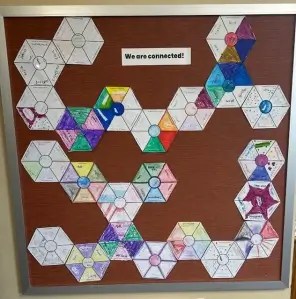
When I start the year with Hexagonal Thinking, students create hexagons about themselves and then connect their hexagons with other similar pieces to visually show their connections. This gives students an easy way to contribute while helping them feel connected to the classroom and each other.
They Encourage Independence
Many teachers appreciate that interactive bulletin boards allow students to work independently while reinforcing classroom learning. Instead of relying on the teacher for every activity, students can revisit concepts, solve challenges, or review vocabulary on their own.
Tammy S. described them as “an independent activity that is always available,” while Joey, a curriculum specialist from Texas, added, “In the classroom (they are a) familiar routine where students can practice various skills. In the hallway (they are a) community learning opportunity.”
They Build Curiosity
Interactive bulletin boards are also a great way to introduce a new unit or spark student interest. They give students a place to ask questions, make observations, and begin exploring a topic before formal instruction begins.
Donna, a seventh and eighth grade ELA teacher from Rhode Island, explained, “I like to use an interactive bulletin board at the start of a unit to develop student interest. As the unit continues, students can use it as a resource and to review.”
They Make Learning Fun
Meagan, a third grade teacher from Arkansas, explained, “I want the kids to be able to learn while having fun. I also want to create a little competition within them.”
Interactive bulletin boards add an element of fun to learning. Challenges, games, and puzzles encourage students to participate voluntarily, and a little friendly competition can motivate students to keep coming back.
Types of Interactive Bulletin Boards
Activate Students in New Learning
Interactive bulletin boards are a powerful way to introduce a new topic and activate student thinking before instruction begins. Rather than starting a lesson by giving students all the information, give them an opportunity to observe, question, and wonder.
Inquiry walls are a great example of this type of bulletin board. Start by displaying a picture, object, quote, or interesting scenario connected to an upcoming unit. Ask students to share what they notice and wonder. Students can add sticky notes with observations, questions, and what they learned.
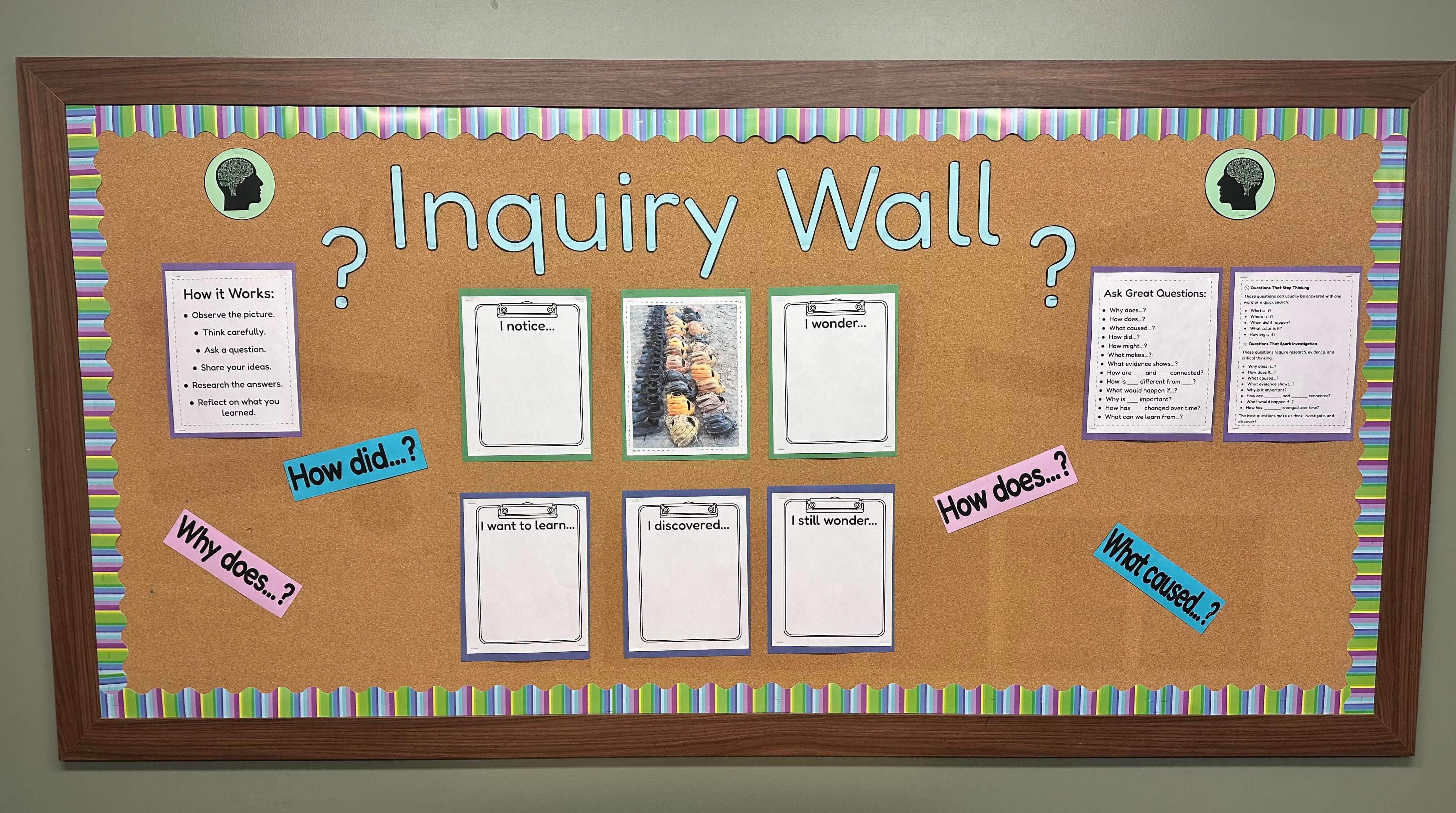
For example, before beginning a science or social studies unit, display an intriguing image and allow students to generate questions. These questions can guide future research and help students become more invested in the learning.
Track the Learning Process
Interactive bulletin boards can help students visualize their progress through a project, process, or learning experience. Instead of wondering what comes next, students can visually track their progress, reflect on their learning, and identify their next steps.
These boards work especially well for multi-step learning experiences such as:
- The engineering design process during STEM challenges
- The writing process from brainstorming to publishing
- Genius Hour or passion projects
For example, during a Genius Hour project, students might place a sticky note with their name on a board showing whether they are currently exploring an idea, researching, creating, or ready to share their final product. This gives students a visual reminder of their progress and helps teachers quickly see where students are in their learning.
Provide Independent Practice
Interactive bulletin boards can also provide meaningful activities students can complete independently. These boards are especially helpful for morning work, early finishers, transitions, or times when students need a challenge.
Instead of handing students another worksheet, provide an activity they can return to throughout the week whenever they finish early. These activities can encourage problem solving, critical thinking, and skill practice while allowing students to work at their own pace.
Examples include:
- Which One Doesn’t Belong?
- Sudoku puzzles
- Logic puzzles
- Math challenges
- Brain teasers
- Vocabulary challenges
- Riddles
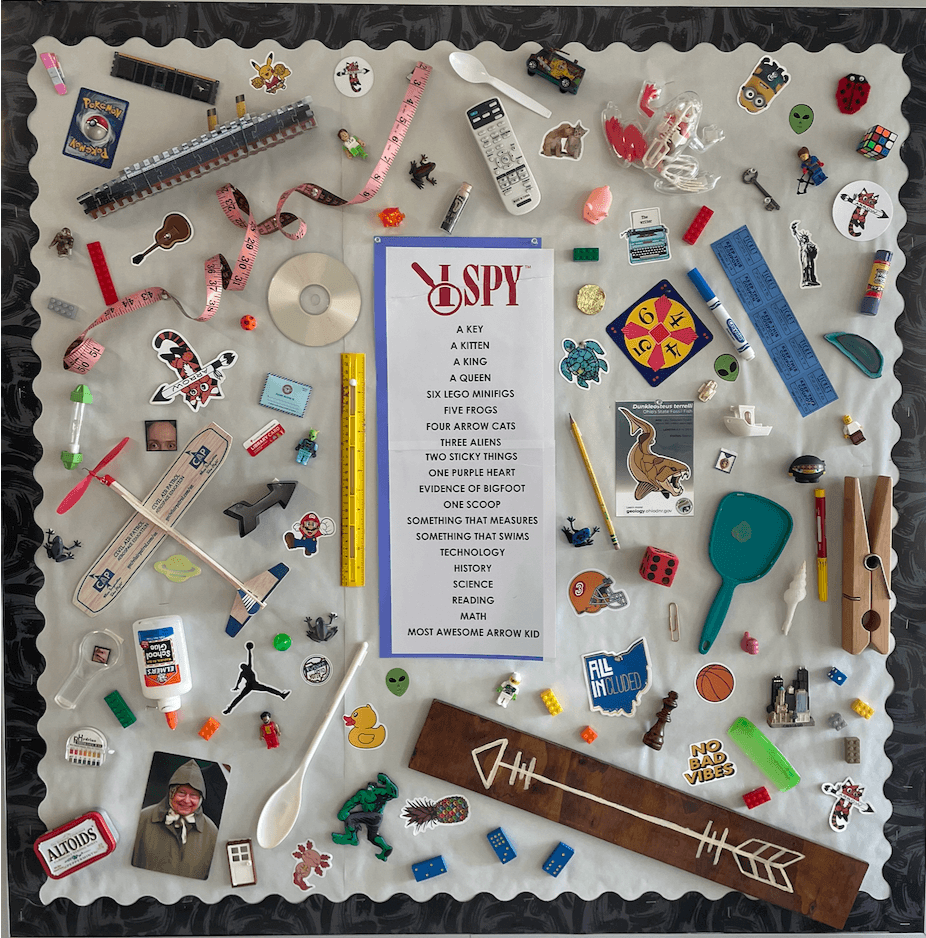
Gail Tanner, a teacher from Ohio, did an I Spy board last year where the prompts required students to solve riddles (i.e., “most awesome Arrow kid” was a mirror; “two queens” was a chess piece and a postcard with Queen Elizabeth).
Tips for Getting Started with Interactive Bulletin Boards
While teachers love the idea of interactive bulletin boards, the biggest challenge they shared was time. Creating, updating, and maintaining boards can feel like one more thing added to an already busy schedule.
Teachers also shared that it can be challenging to create boards that encourage deeper thinking instead of simple responses. The key is to start small and focus on creating a board students will actually use.
Here are a few tips:
Start with a purpose. Decide what you want students to do with the board. Will they solve, reflect, question, create, or practice?
Make it reusable. Joey recommended using laminated pieces or Velcro so students can manipulate information. Tammy shared, “If you prepare them on poster board sections and then add the sections to the bulletin board, you can then reuse them by assembling and disassembling in sections” that can be changed out throughout the year instead of starting over each time. Donna added, “make sure you make your changes before you put the bulletin board away so it’s ready for the next time you want to use it.”
Build in accountability. Students are more likely to use interactive boards when there is a clear routine or expectation for how they should interact with them. Is this an optional item on the early finisher choice board or something that everyone must participate in each week?
Connect it to your instruction. The most effective boards support what is already happening in your classroom, such as introducing a new unit, providing a challenge for early finishers, or helping students reflect on learning.
Interactive Bulletin Board Ideas to Try This Week
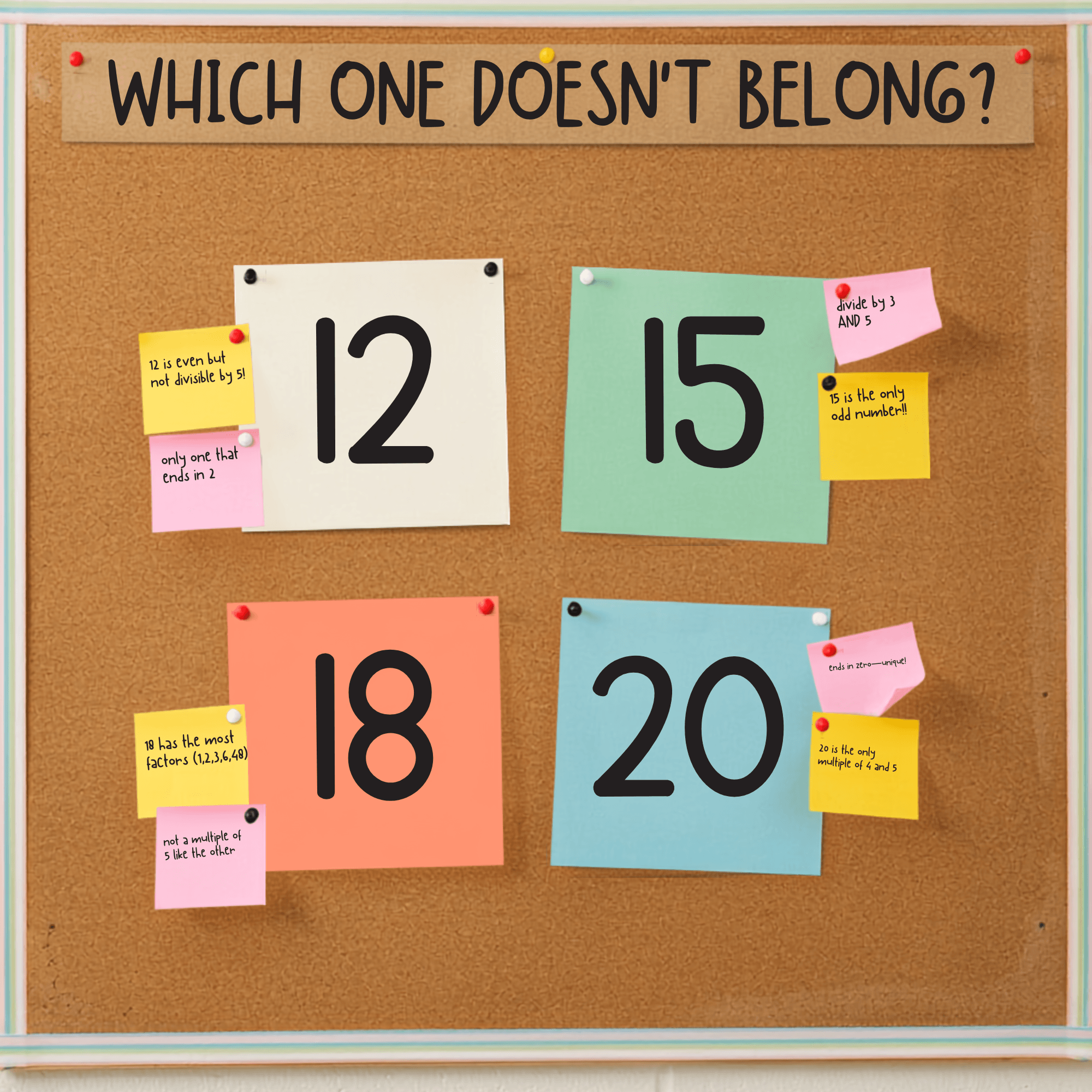
1. Which One Doesn’t Belong?
Display four numbers, equations, pictures, or shapes. Students place a sticky note on the item they think doesn’t belong and explain their reasoning. Read the blog to learn more.
2. Vocabulary Word of the Week
Post blank sheets of paper for each letter in a mystery word. Display a new clue about the word’s meaning or reveal a new letter each day until students correctly guess the word or it is fully revealed.
3. Mystery Number
Meagan, a 3rd grade teacher from Arkansas, suggested displaying a 100 chart alongside a picture of a collection of objects. Give students clues throughout the week, and have them use number sense to eliminate possibilities and determine how many items are in the picture. Clues might include whether the number is even or odd, prime or composite, or a factor or multiple, depending on the age and ability of your students.
4. 50 Questions
Choose a topic of interest and keep it a mystery. For added visual interest, pixelate a picture using the Pixelate effect on Lunapic.com. Students write yes or no questions that you answer using only “yes” or “no.” Challenge them to identify the mystery topic in fewer than 50 questions. This worked especially well in my classroom with different endangered animals.
5. Fact or Fiction?
Post a surprising statement related to your current topic of study. Students decide whether they think it is fact or fiction by placing a sticky note in the appropriate column and explaining their thinking. At the end of the week, reveal the answer and discuss the evidence that supports it.
If you’ve been putting off creating an interactive bulletin board because it feels like too much work, start with one simple idea. Sallie, an ELA teacher from New York, gave this advice: “Start small and create a bulletin board that students will actually use during instruction. It doesn’t have to be elaborate to be meaningful.”

Pick an idea that fits your classroom, give it a try, and see where it takes your students. You might be surprised how quickly an empty bulletin board becomes one of their favorite places to stop, think, and learn.


Leave a comment