Perennials are poking up from the ground. Birds are singing. The days are getting warmer and longer. Students and teachers are feeling restless. Now is the perfect time for activities that keep your class engaged, challenged, and having fun while you count down to spring or summer break.
Please note that some links in this post are Amazon affiliate links. If you click and make a purchase, I earn a small commission at no extra cost to you. Thanks for helping support the site!
ELA Activities
- Spring Word Ladders
- Spring Word Scramble
- Spring Socratic Seminar
Spring Word Ladders
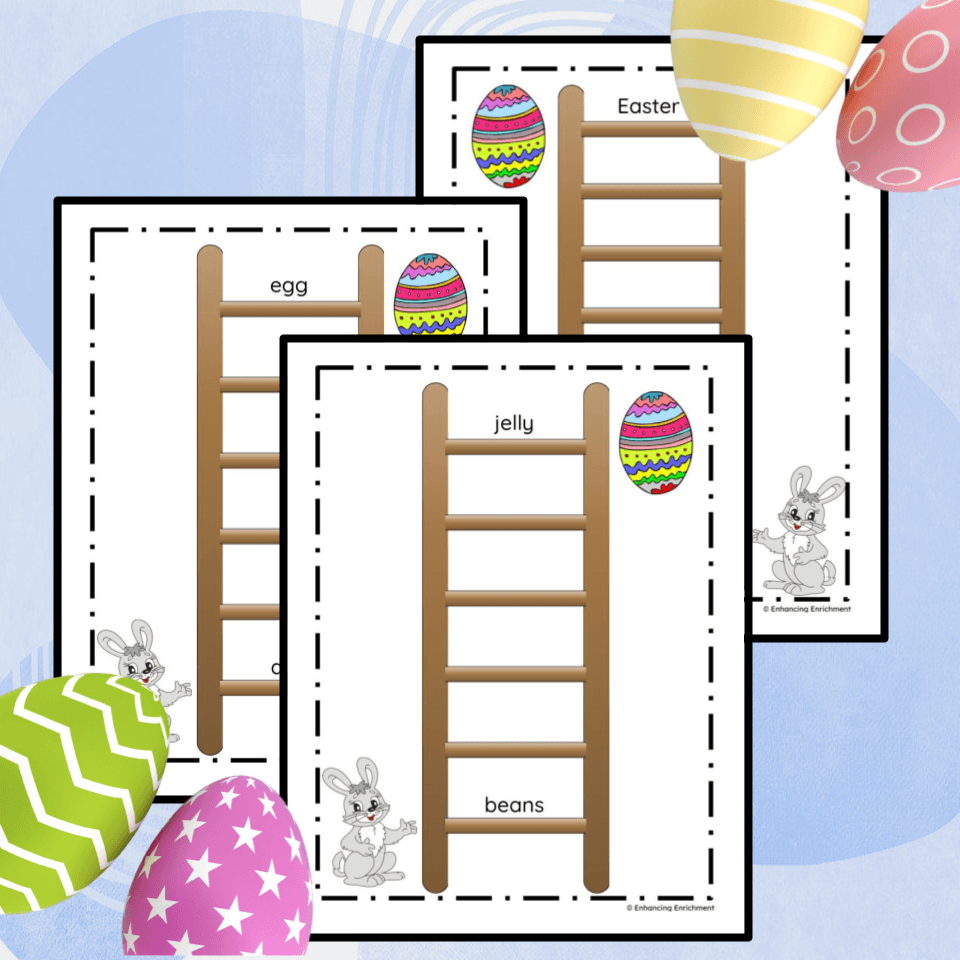
Word Ladders challenge students to move from one word to another by changing only one letter at a time. Each step must create a real word (no abbreviations or proper nouns), and the start and end words must have the same number of letters. Word ladders reinforce word structure and expand vocabulary.
You can create your own word ladders with this word ladder solver or use the ready-to-use Spring Word Ladders (with or without clues). If you’re new to the concept, check out the Using Word Ladders post for tips and strategies or download these free Antonym Word Ladders.
Spring Word Scramble
If you are looking for an activity for early finishers, try Spring Word Scramble. Choose a spring word and rearrange the letters without telling students the beginning word. Challenge them to form as many real words as possible.
Students can work independently as an early finisher task, or you can turn the activity into a collaborative game for small groups or even the whole class. Students earn one point for each letter in a credible word (no proper nouns or abbreviations). The open-ended format encourages flexible thinking, perseverance, and creative problem-solving, making it a meaningful and low-prep option for ELA enrichment.
Spring Socratic Seminar
If you want to spark meaningful discussion and critical thinking this spring, try Socratic Seminar. Pose thought-provoking questions such as:
- Should daylight saving time be abolished?
- Should recycling be required?
- Should there be year-round school?
Fourth, fifth, and sixth grade students will read all about the pros and cons of each topic and form an opinion. They will then cite evidence from the text to discuss and debate their points of view and listen to the points of view of their classmates.
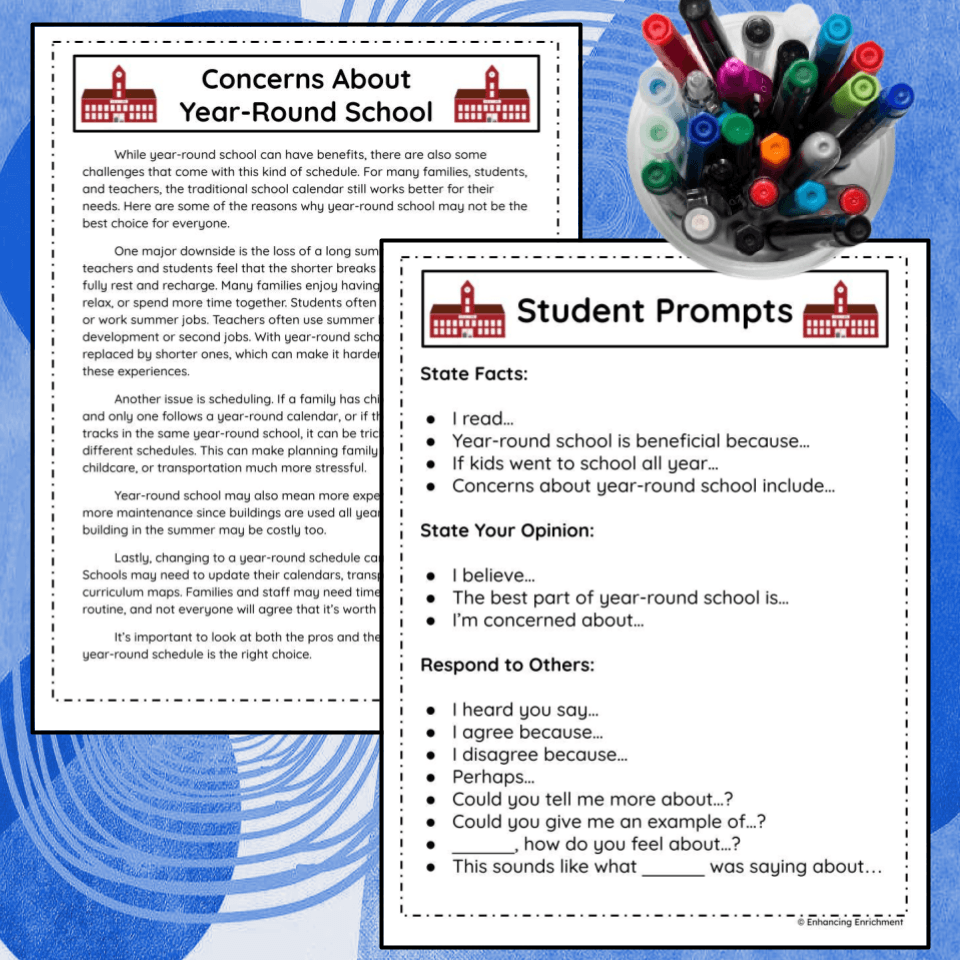
The typical format of a Socratic Seminar involves two circles. The inner circle participates in the discussion. The outer circle keeps track of the interactions between the group members. Students must think critically about the topic in order to analyze information on both sides of the issue. They must also be ready to respond to students who have opposing viewpoints. Read more in the Socratic Seminar blog post or download the free Socratic Seminar graphic organizers to use with any topic.

Math Activities
- Spring Logic Puzzles
- Spring Project-Based Learning
- Math Egg Hunt
Spring Logic Puzzles
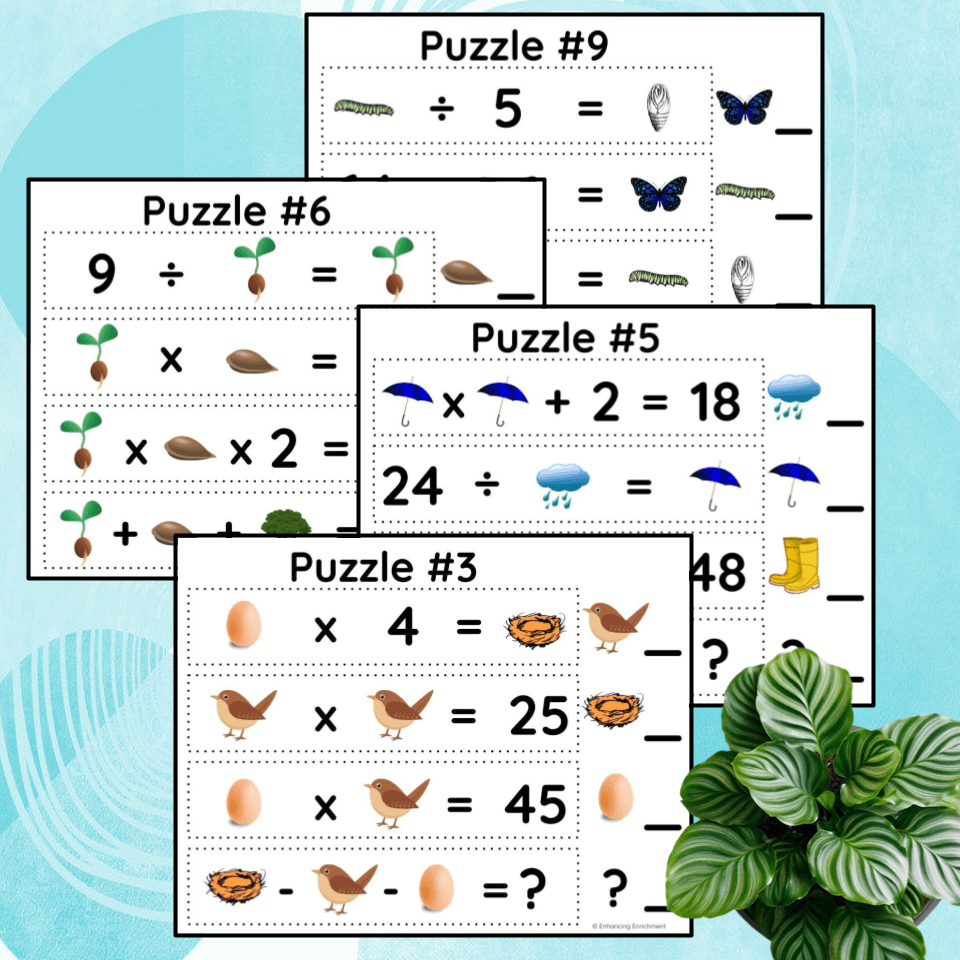
Math logic puzzles are a must-have for challenging high-achieving students. In these puzzles, symbols replace numbers, and students must use their knowledge of equations and operations to determine each symbol’s value. This type of problem-solving encourages critical thinking, strengthens algebraic reasoning, and provides a fun, hands-on way to deepen understanding. Learn more in the Using Math Logic Puzzles post.
These Spring Multiplication and Division Logic Puzzles are designed to engage and challenge advanced math students. After students solve twelve puzzles where pictures take the place of numbers, they are then ready to extend their learning by designing their own logic puzzles to challenge their classmates. Students can create, solve, and self-assess their puzzles using the provided rubric. You can also grab the ready-to-use Easter version.
Spring Project-Based Learning
Project-based learning is a great way for students to see how math connects to the real world. They get to make decisions, explore their creativity, collaborate with classmates, and gain a deeper understanding of the concepts they are learning.
One exciting idea is having students design their own garden. This activity lets them work with volume, decimals, fractions, perimeter, and area while imagining and planning a garden of their own. It works well as an end-of-unit review or as an extra challenge for early finishers.
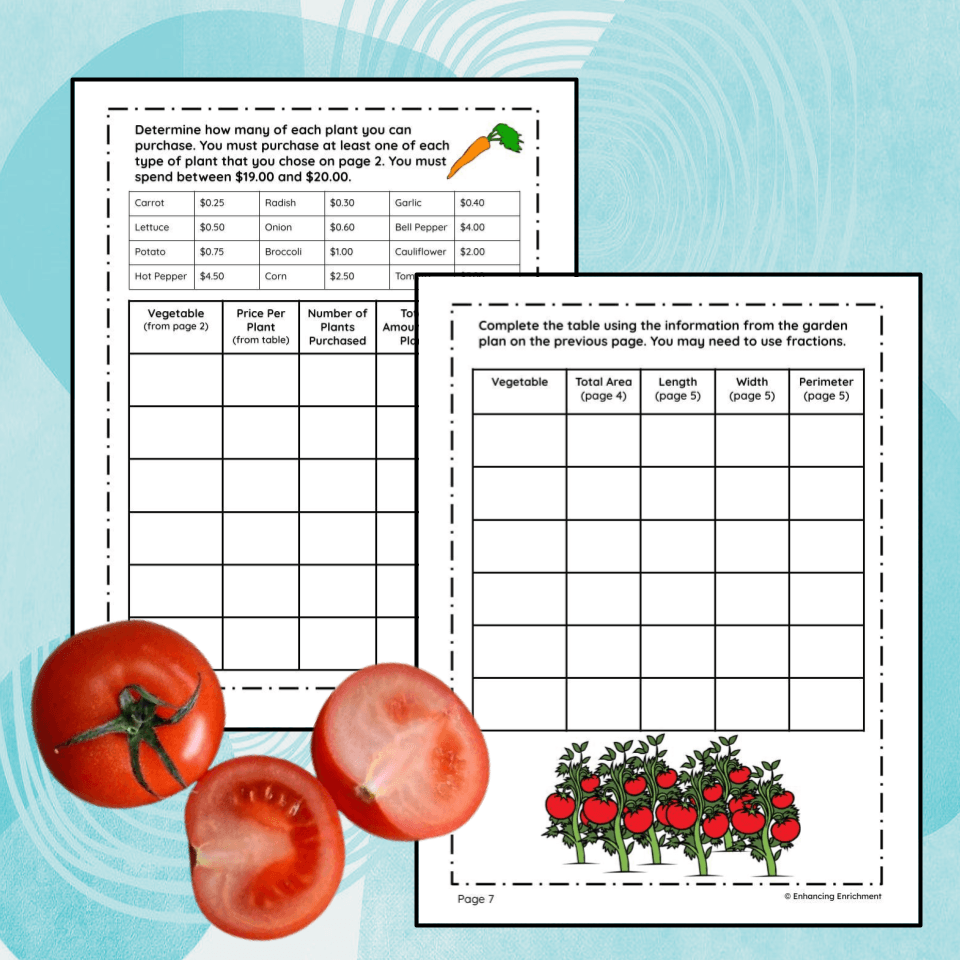
Another creative option is planning a carnival. Students choose supplies and purchase them within a set budget, create a carnival layout using fractions, calculate area and perimeter, and put together a volunteer schedule based on elapsed time. It is a fun and engaging way for them to practice multiple math skills in a real-world context that feels fun.
Math Egg Hunt
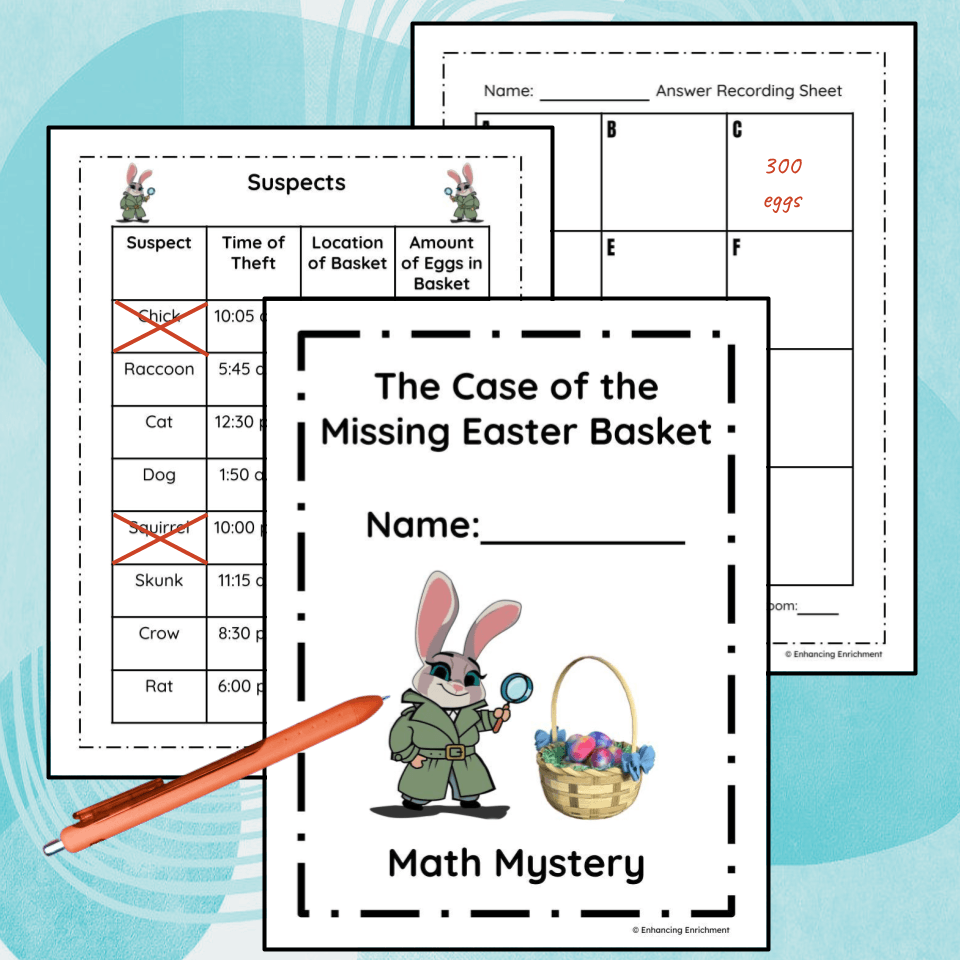
Add some excitement to your usual math problems by turning them into an egg hunt! Instead of giving students a worksheet or task cards, fold each problem and place it inside a plastic Easter egg, then hide the eggs around the room. Students still solve the problems, but the hunt makes them much more excited to participate. For an extra twist, try this with a Math Mystery activity to make the challenge even more engaging!
STEM Activities
- Egg Drop
- Easter Basket STEM
- Sun Shelter
- Recycled Inventions
Egg Drop
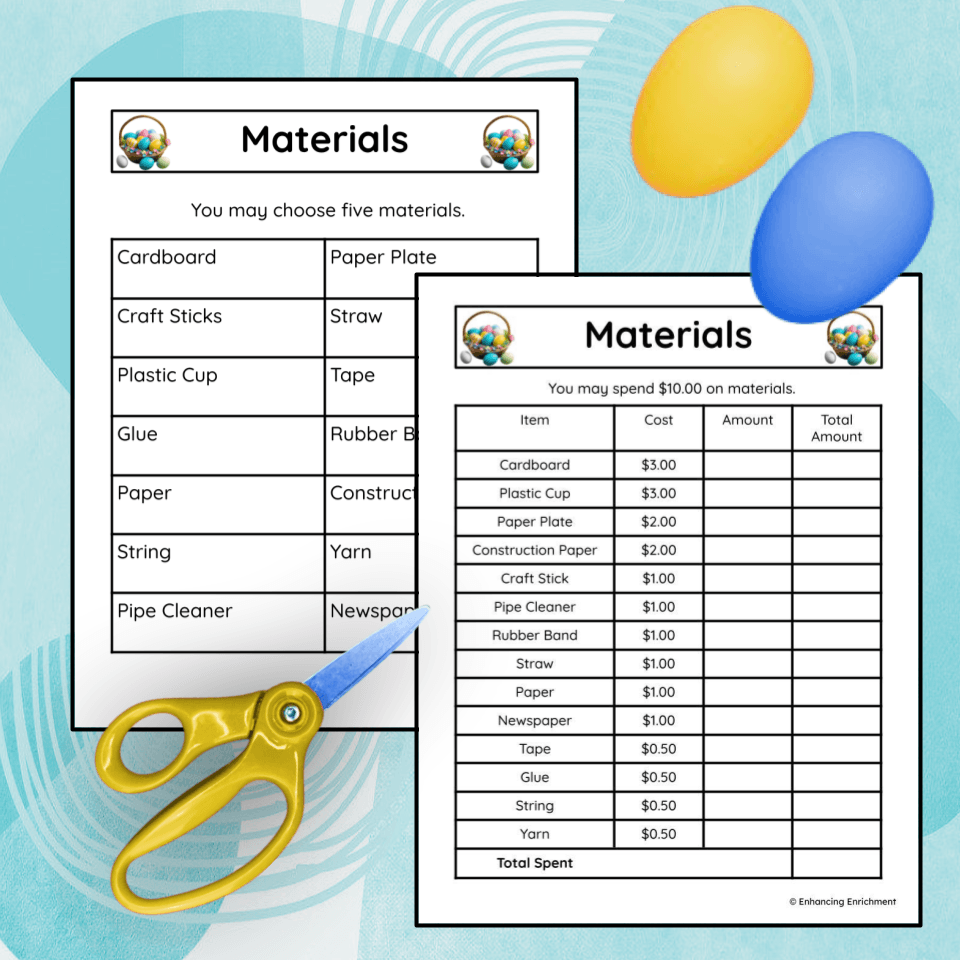
The Egg Drop STEM Challenge is a fun and engaging spring activity that gets students thinking like engineers. Their goal is to design and build a device that protects an egg from breaking when dropped from a height. Start by guiding students through the engineering design process as they plan and build using a limited number of materials or a set budget. For testing, try a practice round with plastic eggs so students can observe results and improve their designs before the final test with real eggs. Begin drops at about three feet and increase the height each round for any eggs that survive.
This activity is a great way to explore concepts like gravity and air resistance while building problem-solving and critical thinking skills. It works well to address engineering standards and get students outside. If you want to save time, you can use the done-for-you Egg Drop STEM Challenge resource that includes planning pages, material options, and reflection sheets to guide students through the process.
Easter Basket STEM Challenge
If you want to take the fun even further, try an Easter Basket STEM Challenge. In this activity, students design and build a basket to help the Easter Bunny carry as many eggs as possible. They work within material limits or a budget, then test their designs by adding weighted plastic eggs one at a time to see how much their basket can hold before it breaks.
What makes this challenge especially engaging is the focus on strength and structure. Students quickly see how handle design, weight distribution, and material choices impact success, which leads to meaningful revisions and deeper thinking.
Sun Shelters
For another creative spring STEM activity, challenge students to build a shelter for a small “creature” made from beads and pipe cleaners. The twist is that the beads change color when exposed to sunlight, so students must design a structure that protects their creature from UV rays. Using a limited set of natural materials like sticks, leaves, grass, and bark, students plan and build shelters that provide the most shade and coverage.
Students can test their shelters at different times of day, such as morning, midday, and afternoon, to observe how the angle and intensity of the sun affect their design. As they observe whether the beads change color, they can make improvements to block more light. This adds a deeper layer of thinking while still keeping the activity simple, hands-on, and easy to set up outdoors.
Recycled Inventions
To celebrate Earth Day, invite students to create something new using recycled materials. They can design inventions that solve a real-world problem or build imaginative creations like robots, tools, or machines. Provide a collection of items such as cardboard boxes, plastic bottles, paper tubes, and packaging, and challenge students to transform them into something useful or creative.
This activity encourages students to think about sustainability while using problem-solving and engineering skills. You can have students share the purpose of their creation and explain how it helps the environment or solves a need.
Spring is in the air, and it’s the perfect chance to bring energy and excitement into your upper elementary gifted and talented classroom. These hands-on, creative activities will keep students thinking, exploring, and collaborating while still learning. With a little planning, you can make the last weeks before break both fun and meaningful for everyone.
 Enhancing Enrichment
Leave a comment