Do you celebrate St. Patrick’s Day in your classroom? St. Patrick’s Day is one of the few holidays that I don’t celebrate at all outside of school, but still enjoy celebrating with my students. It is an opportunity to provide some fun leprechaun fun while still meeting academic standards and challenging gifted and talented students.
Please note that some links in this post are Amazon affiliate links. If you click and make a purchase, I earn a small commission at no extra cost to you. Thanks for helping support the site!

ELA Activities
- Irish Folktales
- St. Patrick’s Day Word Ladders
- Leprechaun Point of View Writing
Irish Folktales
Irish folktales are a fun way to bring St. Patrick’s Day into the classroom while building strong reading comprehension skills. Stories like Jamie O’Rourke and the Big Potato by Tomie dePaola and Tim O’Toole and the Wee Folk by Gerald McDermott introduce students to traditional Irish storytelling with humor and meaningful lessons.
After reading Jamie O’Rourke and the Big Potato, students can analyze folktale elements, discuss the main character’s traits, and explore how the events in the story lead to different outcomes.
Tim O’Toole and the Wee Folk is a great opportunity to discuss themes like luck, generosity, and kindness. Students can also compare the two stories to identify common elements of folklore and the lessons they teach. Activities like these help students practice critical thinking while exploring cultural stories connected to the holiday.
St. Patrick’s Day Word Ladders
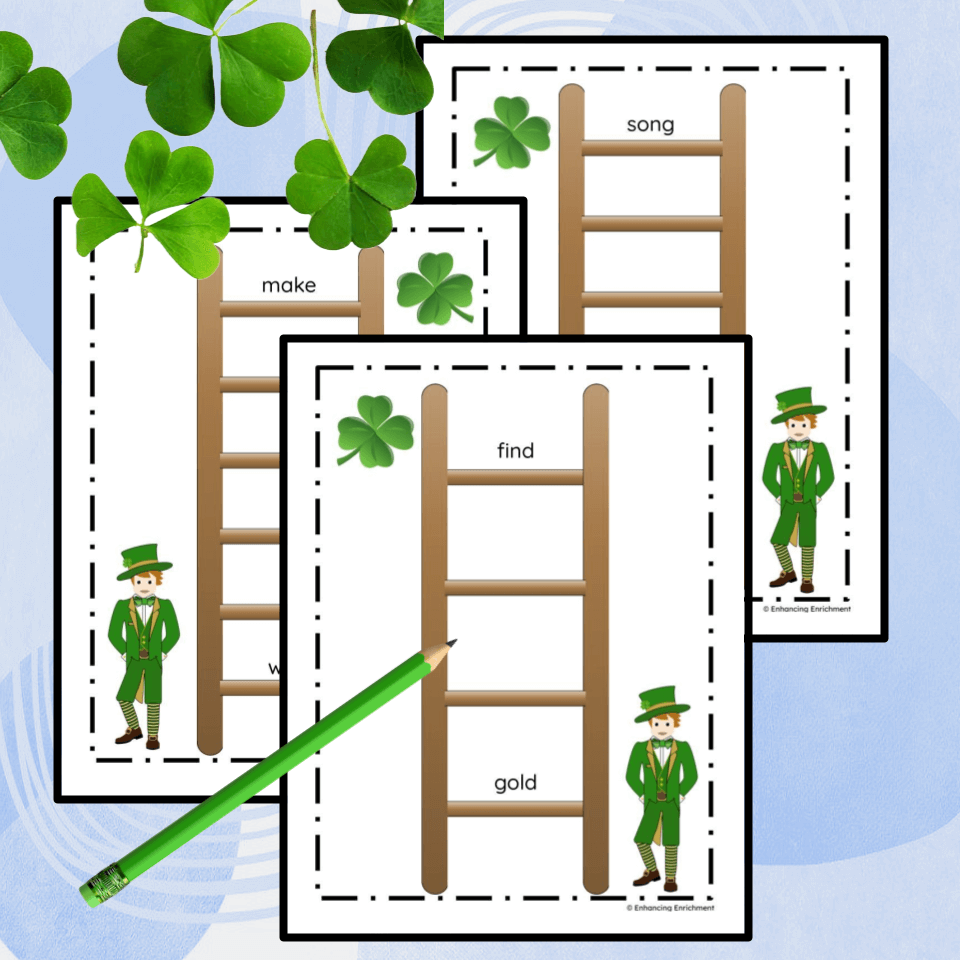
Word Ladders challenge students to move from one word to another by changing only one letter at a time. Each step must create a real word (no proper nouns or abbreviations), and the start and end words must have the same number of letters.
You can create your own word ladders with this word ladder solver or use the ready-to-use St. Patrick’s Day Word Ladders (with or without clues). If you’re new to the concept, grab these free Antonym Word Ladders, or check out the Using Word Ladders post for tips and strategies.
Leprechaun Point of View Writing
Leprechaun Point of View Writing is a fun way to bring creativity into your St. Patrick’s Day activities while strengthening narrative writing skills. In this activity, students write a story from a leprechaun’s perspective. They might imagine a leprechaun trying to protect their gold from curious humans, a leprechaun who accidentally loses their pot of gold, or even one who gets caught by a clever child. Writing from the leprechaun’s point of view encourages students to think about voice, perspective, and character motivations.
For an extra challenge, students can write the story from two perspectives (the leprechaun and the kid who caught them) and compare how the same event looks from different viewpoints. This activity helps students practice narrative writing while developing a deeper understanding of perspective.
Math Activities
- Math Logic Puzzles
- Math Mobile Puzzles
- Math Treasure Hunt
Math Logic Puzzles
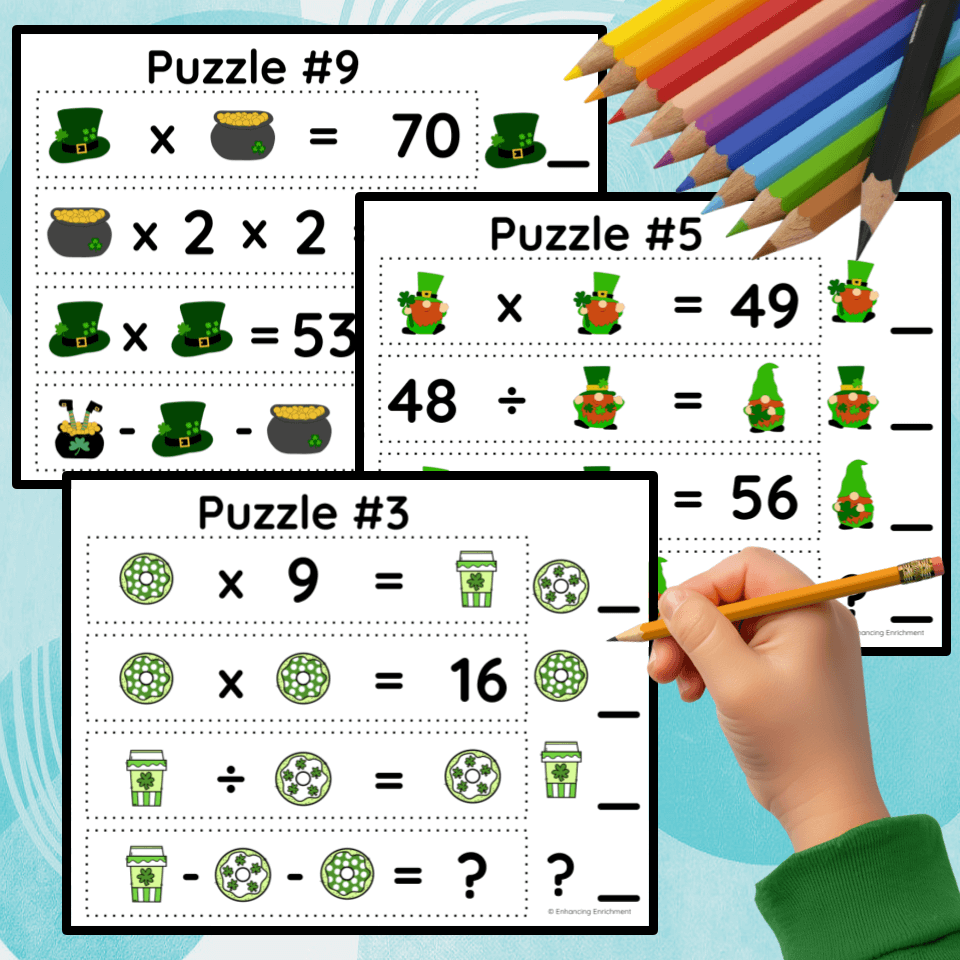
Math logic puzzles are a must-have for challenging high-achieving students. In these puzzles, symbols replace numbers, and students must use their knowledge of equations and operations to determine each symbol’s value. This type of problem-solving encourages critical thinking, strengthens algebraic reasoning, and provides a fun, hands-on way to deepen understanding. Learn more in the Using Math Logic Puzzles post.
These St. Patrick’s Day Multiplication and Division Logic Puzzles are designed to engage and challenge advanced math students. After students solve twelve puzzles where pictures take the place of numbers, they are then ready to extend their learning by designing their own logic puzzles to challenge their classmates. Students can create, solve, and self-assess their puzzles using the provided rubric.
Math Mobile Puzzles
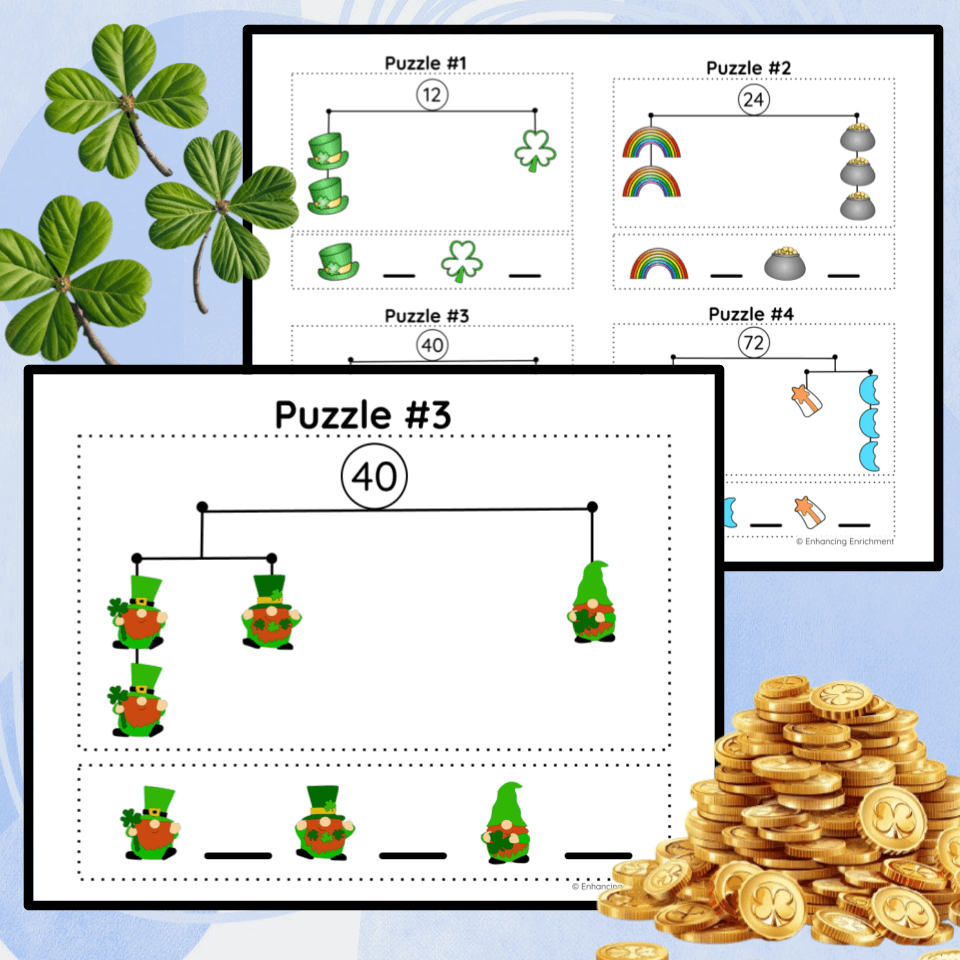
You can also introduce mobile puzzles, which help students explore balance and equality. Each mobile works like a hanging balance where every side must be perfectly even. Using given numbers or pictures, students determine missing values so the entire mobile stays balanced. Read more in the Using Mobile Balance Puzzles post, try some free emoji puzzles, or grab the St. Patrick’s Day version for your classroom.
Math Treasure Hunt
A St. Patrick’s Day Math Treasure Hunt is a fun way to get students moving while practicing problem-solving skills. In this activity, students solve a series of math problems, and each correct answer leads them to the location of the next clue hidden around the classroom. The problems can include skills your students are currently learning, such as multiplication, fractions, or decimals. As students work through each clue, they get closer to the final destination, the hidden treasure!
The last clue leads them to a small reward like candy, stickers, or another prize. This activity adds excitement to math practice and encourages teamwork, critical thinking, and perseverance as students work together to solve the clues and find the treasure.
STEM Activities
- Trap a Leprechaun Chain Reaction Machine
- Rainbow Bridge
- Candy Rainbow
Trap a Leprechaun Chain Reaction Machine
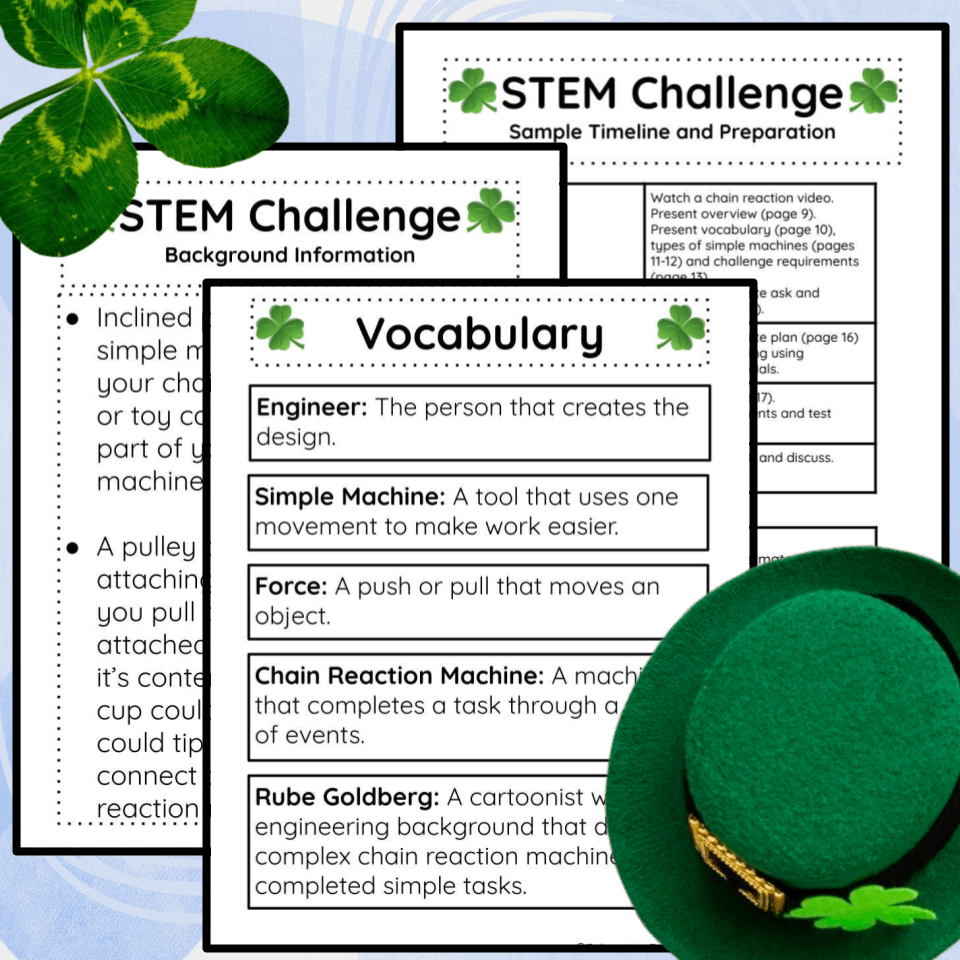
There is nothing more entertaining than trapping a leprechaun. Take this fun activity up a notch for your upper elementary gifted and talented students when they create a chain reaction machine.
Chain reaction machines start with an initial trigger. This could include pushing a ball, knocking over a domino, or cutting a string. This sets events in motion. Energy is transferred to the next object. Events continue without assistance. The final reaction accomplishes a task.
Read more about using chain reaction machines or grab this ready-to-use Trap a Leprechaun STEM challenge.
Rainbow Bridge
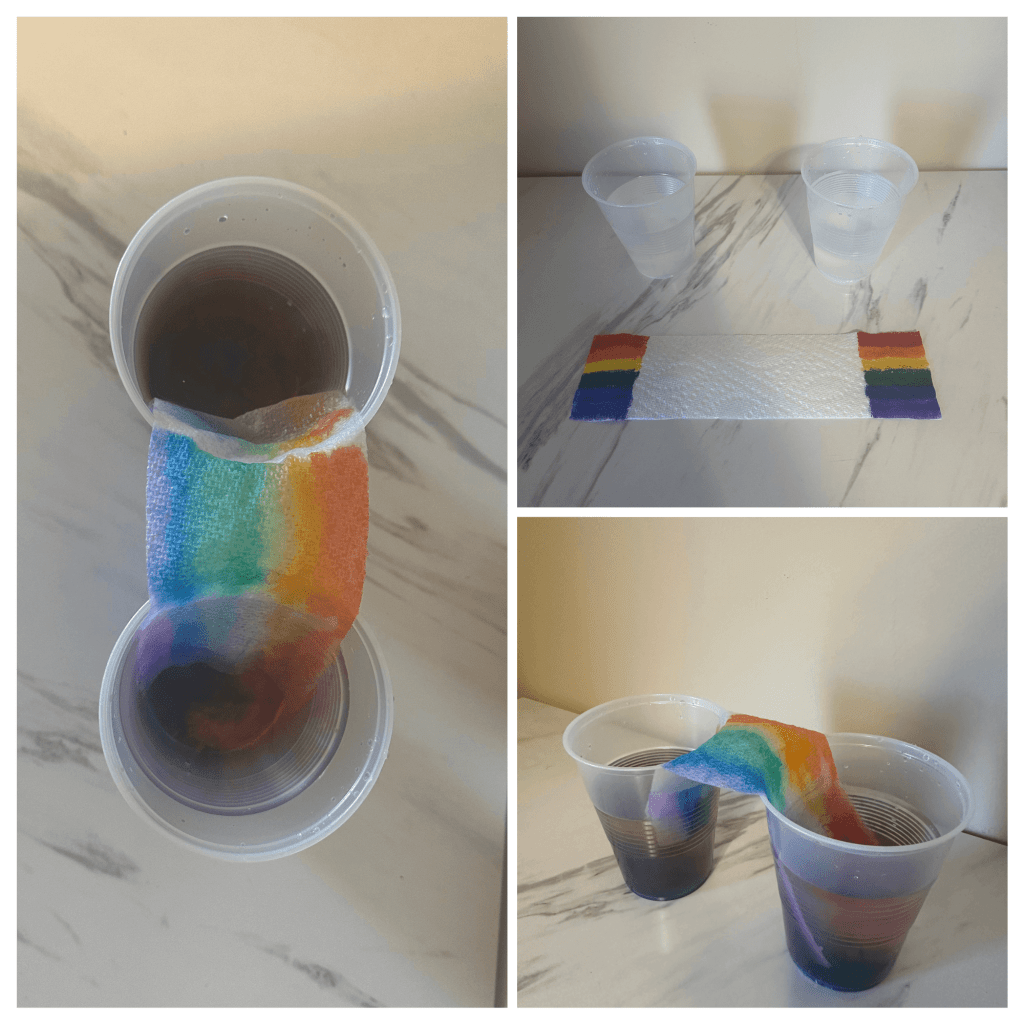
The Rainbow Bridge Challenge is a simple and fun science activity that’s perfect for St. Patrick’s Day. To try it, fill two cups halfway with water and place them a few inches apart. Cut a paper towel lengthwise to create a long strip, then color the ends with rainbow colors using washable markers. Leave the middle mostly blank. Place one end of the paper towel into each cup so it forms a bridge between them. As the paper towel absorbs the water, the colors slowly travel toward the center until they meet and create a connected rainbow.
This happens because of capillary action, which is how water moves through tiny spaces in materials like paper towels. As the water moves, it carries the marker ink along with it. It’s a simple way for students to see science in action. It’s also a great opportunity to ask questions, test new ideas, and experiment with different colors or distances between the cups.
Candy Rainbow
The Candy Rainbow is a similar experiment that is quick and easy to implement. To try it, place Skittles (or a similar color-coated candy) in a circle around the edge of a shallow bowl or plate. Once they’re arranged, slowly pour warm water into the center until it just covers the candy. Within a few seconds, the colorful coating on the Skittles begins to dissolve, and the colors move toward the middle, creating bright rainbow streaks that swirl together.
This happens because the sugar coating dissolves in the water, releasing the dye. The colors spread out from each candy and move toward the center, creating a beautiful rainbow pattern. It’s a fun way for students to observe how substances dissolve in water.

St. Patrick’s Day can be a fun and meaningful way to bring a little excitement into your classroom while still focusing on strong academic learning. Whether your students are exploring Irish folktales, solving challenging math puzzles, or designing creative STEM projects, these activities provide opportunities for critical thinking, creativity, and problem-solving. With a mix of reading, writing, math, and hands-on learning, you can easily create a day that feels festive while still supporting your learning goals and challenging gifted and talented students.

 Enhancing Enrichment
Leave a comment