
Can you hear the groans ripple through the room when the principal announces an icebreaker at the first staff development meeting of the year? I’ll admit, I often sigh the loudest, but when it comes to students, icebreakers actually work. On the first day of school, they break down the awkward silence, help kids find common ground, and might even spark the teamwork needed for that very first group project.
I asked upper elementary teachers for their favorite icebreakers and included some of my own to create this list of go-to icebreakers. Hopefully, you’ll find one (or a few) that help you kick off the year and make your new students feel right at home.
Get to Know You
1. Two Truths and a Lie
When I asked upper elementary teachers about their favorite icebreaker to start the year, the most popular response was Two Truths and a Lie. Students write down three statements about themselves, and their classmates guess which one is the lie. Providing a theme can help guide the game and spark ideas. Some fun options include All About Me, What I Did This Summer, Likes and Dislikes, or By the Numbers (a fun math version). To make this process easier, I pass out note cards because they are quick and easy to write on. As each student shares, classmates hold up their fingers (1, 2, or 3) to show their guess.
This year, I put a twist on it and played Two Lies and a Truth. Students loved the chance to invent things they wished they had done over the summer, and the format encouraged more creativity (otherwise known as fibbing).
2. This or That
The second most popular choice was This or That. In this activity, students are given two options and move to the side of the room that matches their choice. For example: Would you rather go to a water park or an amusement park? Once students move to their side, they can connect with classmates who share the same preference.
3. Four Corners
If you need more choices, this can easily be expanded to Four Corners. In this variation, each corner is assigned a category. You can use categories like favorite subject (math, reading, science, or social studies), preferred recess activity (basketball, playground, tether ball, or talking with friends), or even learning style (visual, auditory, physical, or verbal). Students choose the corner that best matches them and then discuss why they picked it with others in the same group.
4. Stand Up, Sit Down
For a version with less movement, try Stand Up, Sit Down. The teacher makes a statement such as, “I love to read.” Students who agree stand up, while those who don’t remain seated. Students look around to see who shares their preferences.

5. Conversational Uno
Erica, a teacher from New Jersey, shared one of her favorite icebreakers: Conversational Uno. “My favorite ice breaker is conversational Uno where the kids answer different questions based on what color card they put down.” For example, red cards might mean “share your favorite food,” blue cards could be “tell us something you like to do on the weekend,” yellow cards might be “tell about a place you’d love to visit,” and green cards could be “share a fun fact about yourself.”
This activity works especially well because it builds on a game many students already know and love, while keeping the focus on getting to know each other. The colors provide structure and spark conversation.
You don’t have to stick with Uno. You can easily adapt it using playing cards (with each suit tied to a different question category) or even candy like Skittles or M&Ms, where each color corresponds to a prompt.
6. Index Card Game
Shannan, a gifted and talented teacher from Colorado, shared her favorite icebreaker activity: the Index Card Game. She explains, “Everyone gets an index card and we write down facts about ourselves (favorite things, books, quotes, etc.). Then, I collect them and read the facts without sharing the name. I read them randomly and have people guess who it is.”
What makes this activity special is that it doesn’t end on the first day of school. Shannan continues, “We use them all year, and the kids love them! When we have downtime, the kids beg to ‘do index cards.’” Not only does this game break the ice at the beginning of the year, but it also creates an easy way to revisit student connections again and again.
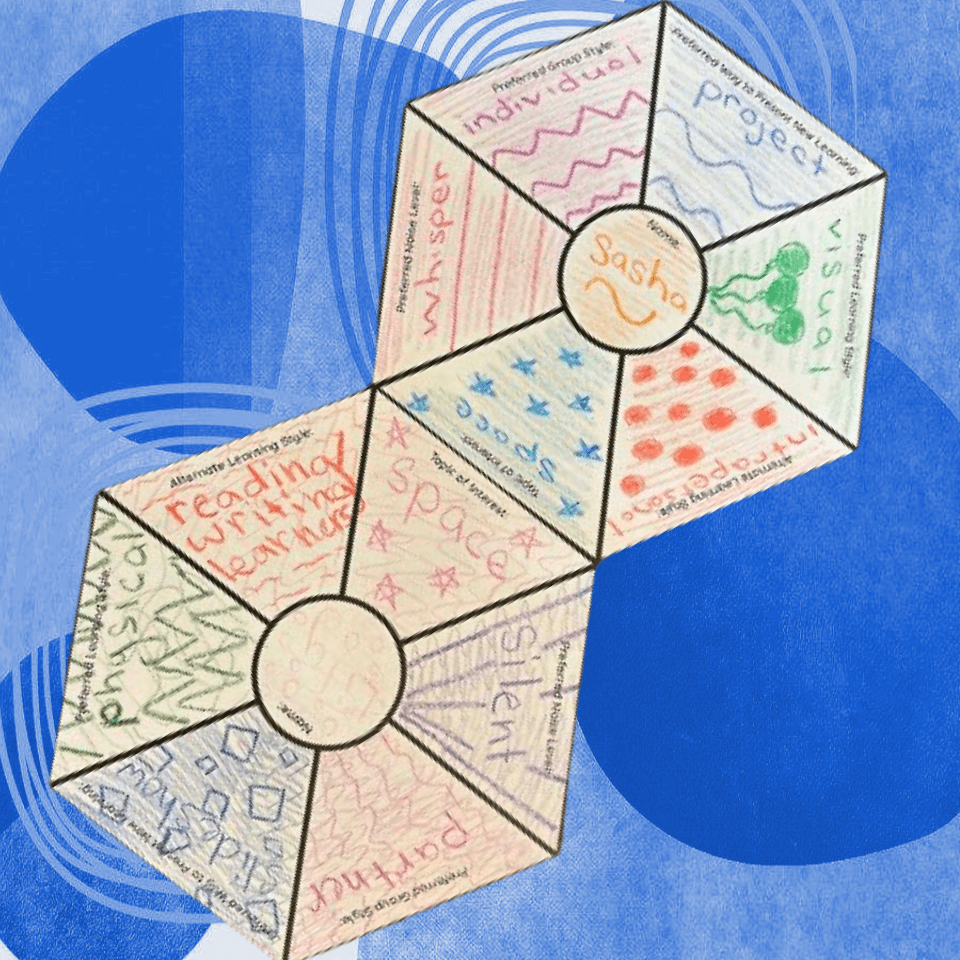
7. Get to Know You Cube
Get to know your students and how they learn best with a 3D cube. In this activity, students identify their learning styles, character traits, and their favorites to share with their classmates!
The 3D cube can then be kept in a visual location to use as a name tag, learn about other students, and serve as a daily reminder of each student’s learning preferences. The 3D cube is ready to print and use.

Collaboration
8. Hexagonal Thinking
Hexagonal thinking is my personal favorite because it helps students see how they are connected to one another. Each student fills in a hexagon by answering prompts to share their learning preferences, interests, favorites, or even fun facts using numbers for a math twist.
Once completed, students place their hexagons together, matching sides with others who share similar responses. The goal is to link all the hexagons into one connected group, which can then be displayed as a reminder of the ways your class is connected. You can create your own by printing out a hexagon and dividing it into six sections. If you would like a ready-to-use version, the Back to School Hexagonal Thinking resource is available to print and use right away.
9. Tallest Tower Challenge
In this classic STEM activity, students work together using limited materials to build the tallest tower possible within a set time limit. Materials can vary. Try plastic cups, index cards, or toothpicks (or spaghetti noodles) and mini marshmallows.
For an added twist, especially if you’re using plastic cups, students are not allowed to touch the cups with their hands. Instead, give each team one large rubber band. Each student either gets a paper clip or a piece of string tied to the rubber band. Working together, they must pull on their paper clip or string to stretch and guide the rubber band around the cups in order to stack them into a tower. The challenge is to build the tallest tower possible using teamwork and strategy.
10. Survival Game
Nothing requires teamwork like being stranded on a deserted island. In this fun challenge, students must work together to determine the seven most necessary items to take off the sinking ship. Students first make an independent list. Then they join a group. The group determines their motto and how they will handle disagreements before determining their group list of 7 items. Will they survive? More importantly, did they work together? Grab this fun teamwork challenge.

11. Puzzle Exchange
In this teamwork challenge, each group works together to complete a small puzzle. You can use a 24-piece puzzle from the dollar store or create your own by printing an image and cutting it into pieces.
For a fun twist, give one puzzle piece to a different group. This way, no team can complete their puzzle without problem-solving, communication, and collaboration with others.
12. Classroom Scavenger Hunt
If you want your students to become more familiar with your classroom, or your digital classroom, a scavenger hunt is a great way to combine teamwork with exploration. Create a simple chart listing the items or features you want students to find.
Working together, each team searches for the items and records where they found them. The first team to complete the chart wins!
Starting the year with icebreakers sets the tone for a positive, connected classroom. Whether it’s towers, puzzles, or scavenger hunts, these activities help students laugh, problem-solve, and build community. Did you find a new idea to try? Share your favorite icebreaker in the comments!

 Enhancing Enrichment
Leave a comment