
Choice boards are a great tool to give students ownership over their own learning. By offering structured options, students feel empowered, leading to more engagement, ownership, and success.
What Are Choice Boards?
You are probably already using some version of choice boards in your classroom. They are a perfect way to engage early finishers. Most people think of a three-by-three grid with different options when they think of a choice board, but choice boards can look very different. Anything that gives students choice over their own learning can be thought of as a choice board. This could be a list of must-dos and may-dos, a shelf with a variety of math games, or a Bingo board where students cross off activities to form three in a row. Creating a structured recording sheet with a certain number of required activities helps define choice boards as assignments instead of just free time.
Why Use Choice Boards?
If you were told that after you finished your work, you would get more of the same work, would you be in a hurry to get your first task completed? This is often what happens to our gifted and talented students. They are not in a hurry to complete their work because they know they will just get another assignment. You can read more about good options for early finishers in this post. Choice boards give students control over their own learning. They are able to choose a preferred task while still learning new things.

How To Use Choice Boards
Choice boards can be used for several different reasons. They can be used to meet the learning styles of students, provide a variety of ways to deepen understanding, or provide engaging choices for early finishers.
Meet Learning Styles
Students learn in different ways. Some students are visual learners, while others are auditory, kinesthetic, or reading and writing learners. You can read more about meeting students’ needs based on their learning styles in this post. One way to meet the needs of all of your learners is to allow students to choose how they process and present their new learning.
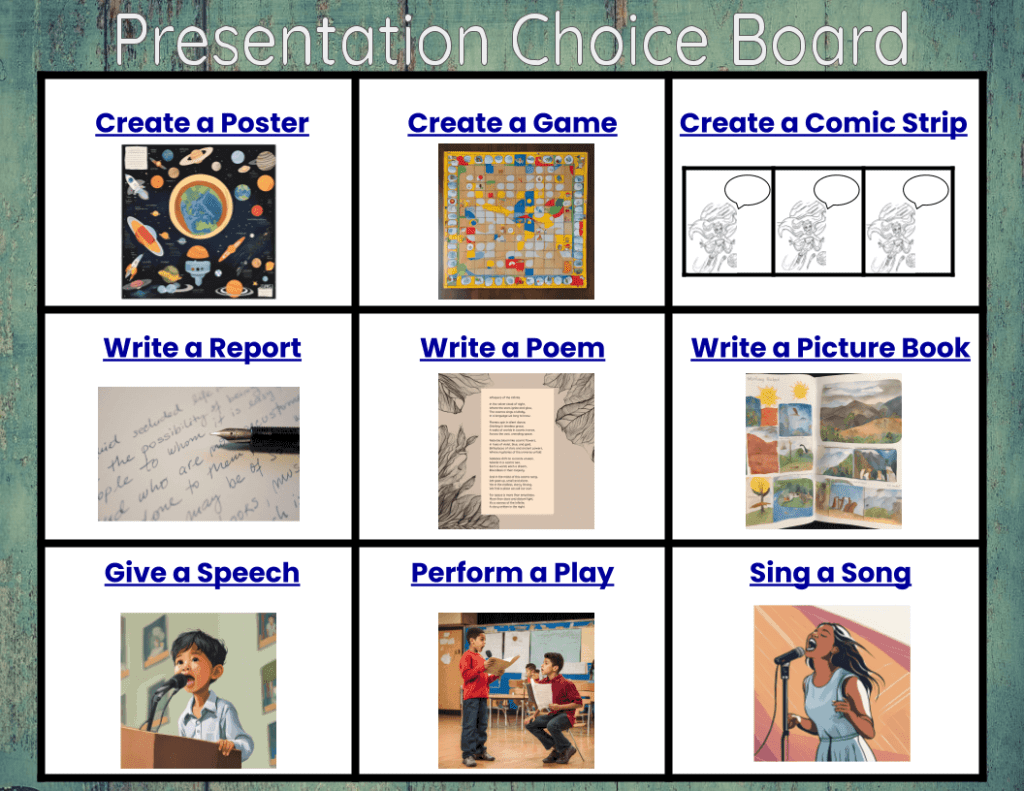
Allowing students a choice in how they present this information is a great way to incorporate their learning styles and allow for creativity. Visual learners might choose to create a poster or slideshow. Auditory learners might choose to create a podcast or video. Kinesthetic learners might create a skit or game show. Reading and writing learners might write a poem or song.
You can get this free presentation choice board here.
Deepen Understanding
Gifted and talented students need to go beyond a surface level of understanding. Choice boards allow them to deepen their understanding of a specific topic without moving on to a new topic. For example, this decimal choice board focuses on problem-solving and critical thinking, all centered around decimals. Students choose between solving math logic puzzles where pictures stand for decimals, looking at four different decimals and determining why each one is unlike the other three, solving hangar diagram balance puzzles where the total value of the entire puzzle is given and students must identify the value of each shape, or identifying missing decimals in a receipt. In each of these choices, students are adding, subtracting, multiplying, or dividing decimals, but each activity requires students to think critically. No matter what choice a student makes, they are still required to use higher-level thinking and demonstrate their understanding of decimals.

Choice boards can also be centered around a topic or theme. These invention choice boards allow students to read, write, and complete word puzzles all about inventors and inventions.
- Reading Choice Board: Students read books and articles about inventions and inventors. They then choose between analyzing fictional characters, ranking inventions, or determining the ethical implications of an invention.
- Writing Choice Board: Students choose between informational, narrative, persuasive, opinion, and creative writing prompts. They are able to write a newspaper article, a play, or a journal entry based on their interests.
- Word Work Choice Board: Students will increase vocabulary, analyze words, and engage in critical and creative thinking. They will choose between creating an acrostic poem, solving the mystery word analogy puzzle, or choose from two versions of word ladders.

These choices allow students to choose an activity that they find fun and engaging while still learning more about a specific topic.
Provide Choices
Choice boards can also be used to keep students engaged. These reading and math choice boards allow students to choose from a variety of online games. These are fun and engaging without just being more extra work. They also cover a variety of topics so students can self select a game that fits their needs.

Create Your Own Choice Board
You can create your own choice board with a few simple steps. First, choose a concept or topic that you would like students to explore. Next, choose a format. While a three-by-three grid is common, you can adjust the layout to meet your needs. Decide on how many choices you want to offer and create a matching grid. Then, plan your activities. Try to include a mix of learning styles and level of difficulty based on your students’ current abilities. If you are planning activities for only gifted and talented students you can have all of the choices focus on higher-level thinking skills. However, if you are creating choice boards for an entire class with a range of academic abilities, it might be best to group choices based on ability level. This ensures that all students are challenged appropriately while still having the freedom to make meaningful choices in their learning. Finally, determine how many of the activities students must complete and consider providing a rubric to clarify expectations and grading criteria.
Students are more engaged and motivated when they have agency over their own learning. Agency includes having voice, choice, and ownership. Choice boards are great for this. Having a variety of options allows students to choose an activity that fits their learning needs and style. By thoughtfully designing and implementing choice boards, you can transform your classroom into a space where every student takes ownership of their education, making learning both personalized and enjoyable.

 Enhancing Enrichment
Leave a comment