
Are you looking for an interesting project to help your students learn about physics and engineering in a fun and engaging way? Look no further than the chain reaction machine. It combines simple machines to complete a task through a series of connected events.

Who Was Rube Goldberg?
Rube Goldberg was an American cartoonist in the early 1900s. His engineering background helped him design cartoons that depicted complex machines used to accomplish a simple task such as watering a plant or opening a can. While Rube Goldberg did not create physical inventions of his cartoons, he now inspires people everywhere to bring these inventions to life.
How Does a Chain Reaction Machine Work?
Chain reaction machines start with an initial trigger. This could include pushing a ball, knocking over a domino, or cutting a string. This sets events in motion. Energy is transferred to the next object. Events continue without assistance. The final reaction accomplishes a task.
Examples of Chain Reaction Machines
If your students are unfamiliar with Rube Goldberg machines, it is a great idea to watch some in action first. I like to start with complex examples and then move on to machines that are easier to build. Joseph’s Machines on YouTube is a great place to start. My students particularly like The Lunch Feeding Contraption. OK Go also creates a complex chain reaction machine in their music video This Too Shall Pass. Once students have an idea of what chain reaction machines look like in action, they can start thinking about what they would need to do to create their own machines.
In this simpler example, the tennis ball is released. It goes down the inclined plane and hits the wedge to knock down the dominoes. The string on the pulley is released. The cup comes down to trap the turkey.

Items to Use in a Chain Reaction Machine
When thinking about items to include in a chain reaction, it is important to include a variety of items.
- Items That Roll: Golf balls, tennis balls, ping pong balls, marbles, or toy cars
- Items to Make Ramps: Cardboard, books, blocks, or paper towel tubes
- Items That Create Movement: Dominoes, balloons, a fan, or a catapult
- Items That Store Energy: Rubber bands, springs, or pendulums
- Items to Create More Simple Machines: Rope, string, paper or plastic cups, wheels, buildable cars, screws, or wood wedges

Students create a chain reaction machine that is started with only one force and contains at least two simple machines. These are the simple machine choices.
- Pulley: A pulley includes an axle, wheel, and rope. An axle is a rod that goes through the pulley’s wheel. The rope goes around the pulley. When you pull the rope, it lifts the weight on the other end. Pulleys are used in wells, sailboats, and cranes.
- Lever: A lever includes a beam and a fixed hinge known as a fulcrum. When force is applied to one side of the beam, the other side can lift the load. Pliers, scissors, wheelbarrows, and seesaws are examples of levers.
- Inclined Plane: An inclined plane is a ramp. One side is higher than the other. It allows you to use less force to move an object. It helps objects roll downward. Examples of inclined planes include skateboard ramps, slides, and escalators.
- Wheel and Axle: Wheels are connected by an axle (rod) that turns the wheels. The wheel and axle reduce friction so it is easier to move. Doorknobs, bicycles, and cars all use wheels and axles.
- Wedge: A wedge is a triangular tool. It has a thick end and a thin, pointed end. Force is applied to the thick end to help it cut, split, or hold back. Axes, knives, and doorstops are all examples of wedges.
- Screw: Screws hold objects together. The screw consists of an inclined plane wrapped around a cylinder. They use threads to help them connect objects. Bottle tops, light bulbs, and cork openers all use screws.

Inclined planes are the easiest simple machine to include in your chain reaction machine. Have a ball or toy car roll down a ramp as a part of your chain reaction machine.
A pulley can be created by attaching a rope to a cup. When you pull the side of the rope not attached to the cup, the cup and it’s contents will raise up. The cup could contain a ball that you could tip with the pulley to connect to the rest of your chain reaction machine.
Incorporating Science Standards
This project can help students understand both energy and engineering. Students can learn that stationary objects have stored potential energy. When released, they convert to kinetic energy. They can also learn about mechanical energy transfer when one object (like a domino) hits another object and the energy transfers.
Students will also learn about the engineering design process by asking, imagining, planning, creating, testing, improving, and reflecting on their chain reaction machines.
- Ask: Determine the question that you need to solve.
- Imagine: Determine the possibilities.
- Plan: Sketch and label a plan.
- Create: Create a chain reaction machine with classroom materials.
- Test: Test out your machine.
- Improve: Make adjustments and test again.
- Reflect: Reflect on your machine and determine what went well and what could have gone better.
Holiday Fun
This is a fun addition to your classroom for holidays. You can use these ready-to-go activities to trap a leprechaun for St. Patrick’s Day or catch a turkey for Thanksgiving. The mouse trap activity is ready to print and use any time of the year.
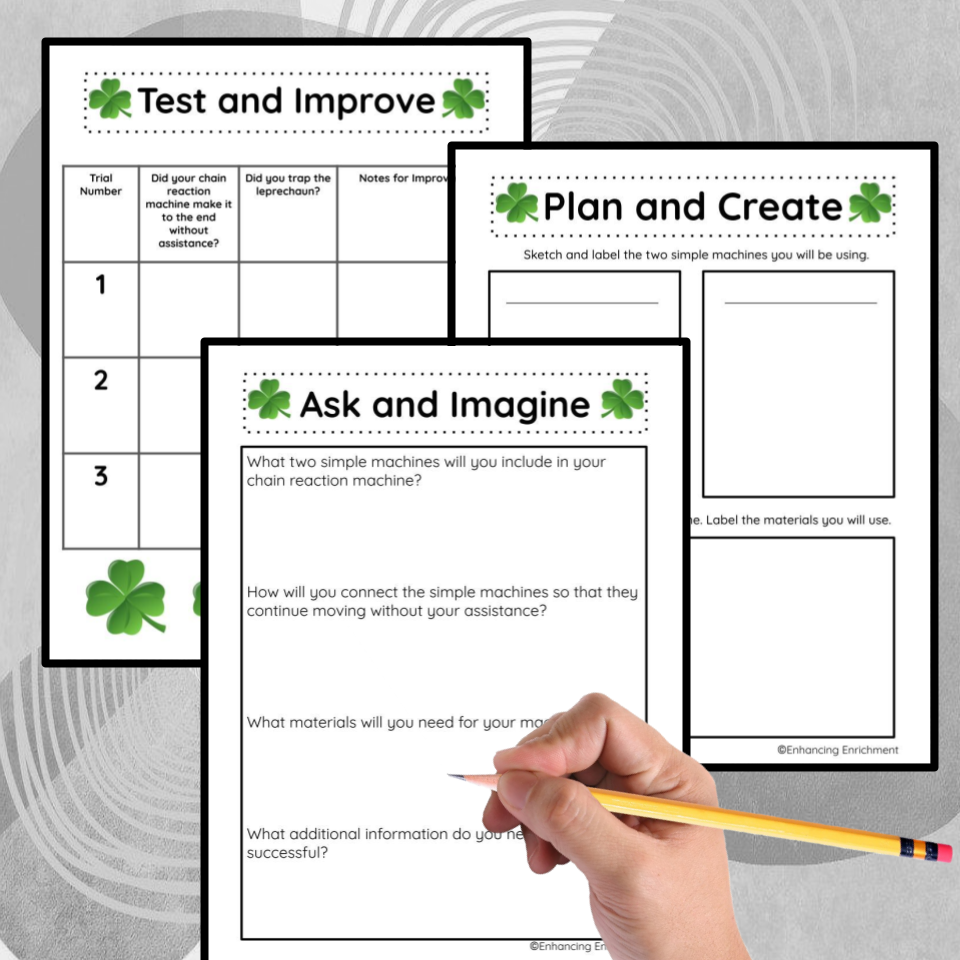
This hands-on project not only reinforces science standards but also adds holiday fun. It’s a great way to engage students in STEM while encouraging creativity and problem-solving skills. You can read more about incorporating STEM projects in your classroom in this post.

 Enhancing Enrichment
Leave a comment