
Are you looking for a critical-thinking math activity that engages and challenges your gifted and talented students? “Which One Doesn’t Belong?” (WODB) is a perfect math routine for your classroom. Everyone can participate and provide different answers, yet all of the answers can be correct! Keep reading to learn more about how WODB can transform how your students think about math.

How WODB Works
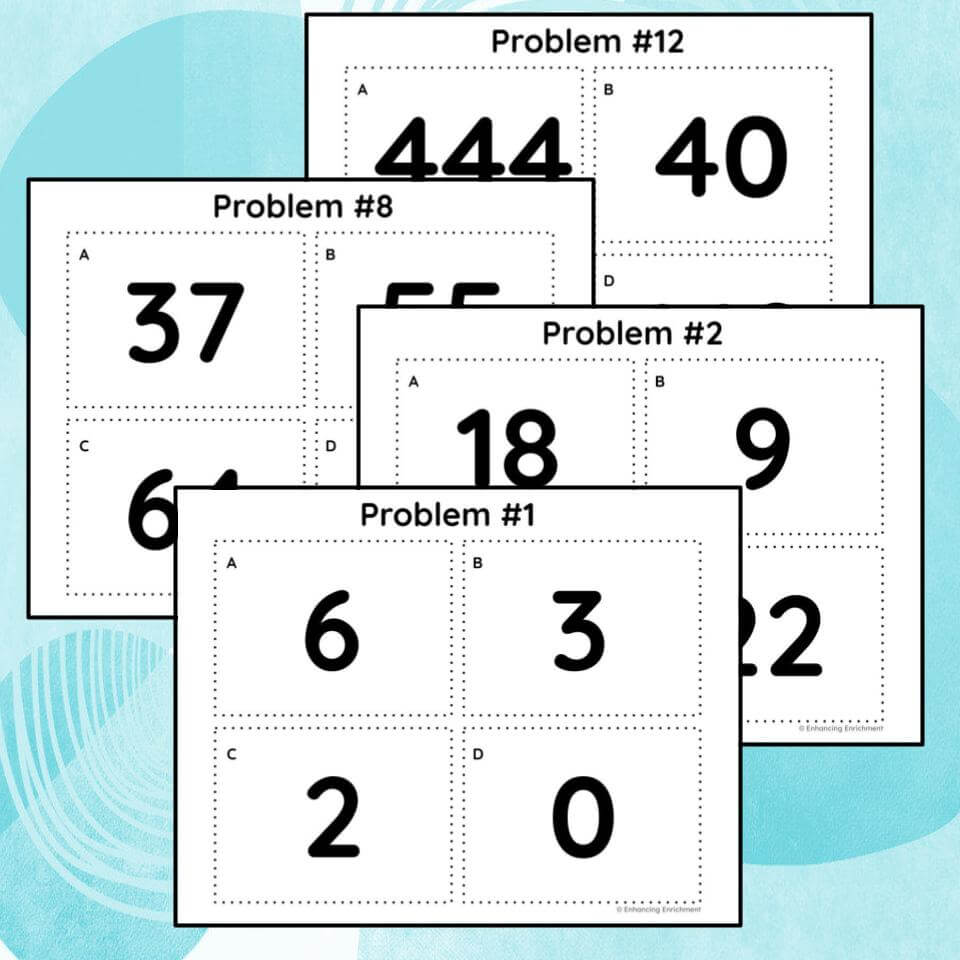
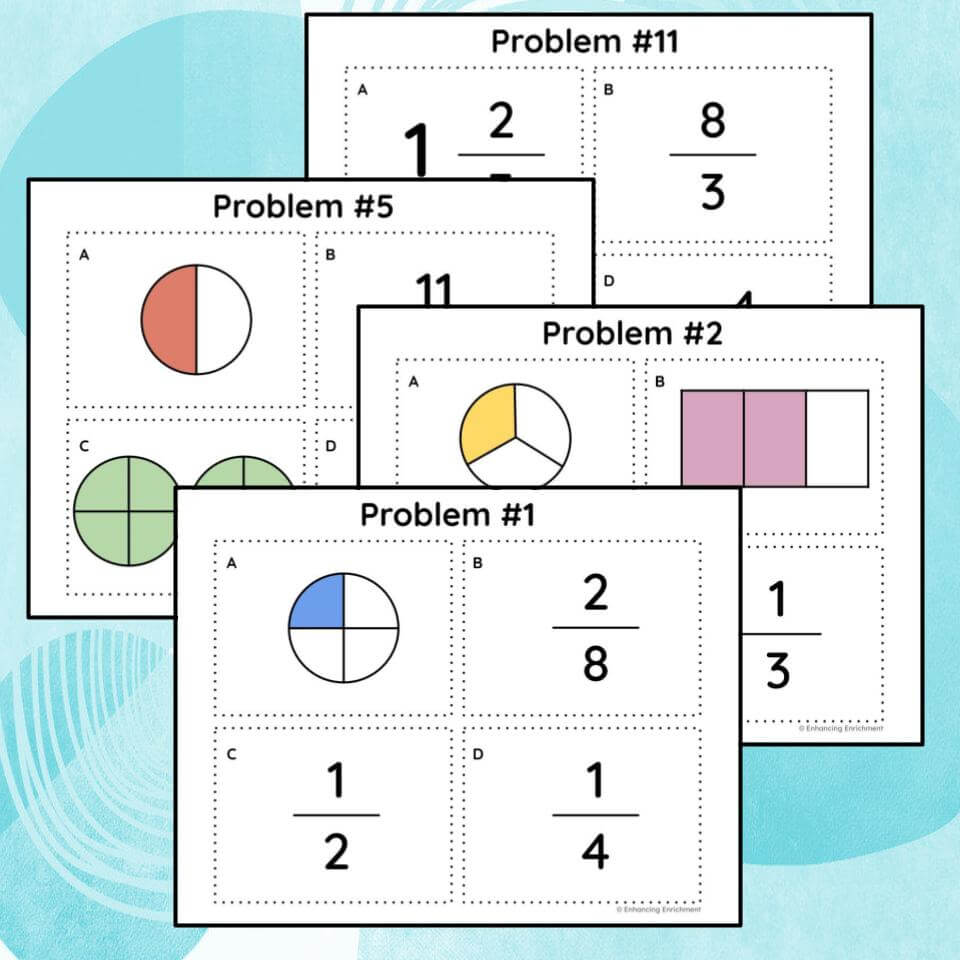
If you are not familiar with the WODB routine, it involves displaying a group of four images, numbers, or equations. Students identify which one is not like the others and describe why it is unique using mathematical vocabulary and reasoning. Students are then challenged to find a reason why each representation is unlike the others. There are many correct answers, allowing students to respond based on their current level of mathematical understanding.
Benefits of Using WODB
- Accessible to All
- Encourages Divergent Thinking
- Fosters Mathematical Discourse
- Introduces New Concepts
Accessible to All
One of the main benefits of WODB is that everyone can participate with their level of mathematical understanding. This is known as a “low floor, high ceiling” activity because it is easy to access, but expansion is also possible. Even in a gifted and talented classroom, students have differing abilities. Students can look for easier concepts, such as different digits, odd or even numbers, or different place values. Students with more complex understanding can answer by converting a decimal to a fraction or comparing the multiples and factors of each number.
Students will benefit from listening to other students share their thinking and reasoning. There are lots of answer possibilities. Gifted and talented students should be challenged to find a reason why each representation is unique so that they can expand their thinking.

Encourage Divergent Thinking
Gifted and talented students thrive on divergent thinking. Divergent thinking is the process of generating multiple ideas and solutions to a problem. In WODB students are encouraged to generate multiple solutions and justify their thinking with mathematical reasoning. Encourage students to move past the surface-level answers. This involves increasing wait time to give students a chance to think on a deeper level. Wait longer than it feels comfortable to give everyone a chance to answer. You can also guide the discussion by asking open-ended questions like, “What makes this one different?” or “Can you explain why you chose that answer?” These questions will encourage further analysis and reasoning.
Foster Mathematical Discourse
In WODB students must explain their reasoning. This requires them to break down their thinking process in a way that others can understand. This is often difficult for gifted and talented students and something that they can develop with repeated practice. Students should also be encouraged to use mathematical vocabulary related to the concept. This can be fostered by having math vocabulary words posted in your classroom.
Introduce New Concepts
“Which One Doesn’t Belong?” is also a great way to introduce new mathematical concepts and vocabulary in a fun and engaging way. You can display problems with a new concept to determine what students already know and then explain concepts that students did not mention. This is a low-stakes activity so it can improve your classroom community and make students feel comfortable answering. Examples of concepts that can be used include shapes, numbers, fractions, decimals, equations, and graphs.
How to Use
- Class Warm-Up
- Independent Work
- Students Create
Class Warm-Up
The most common way to use WODB is as a warm-up with the whole class. It will help students think mathematically and prepare for the lesson, and it is also the best way to foster mathematical discourse. Display a problem on the board with four related numbers, pictures, graphs, or equations. Provide students with five minutes of think time to record their thoughts. Students should first identify one number that they think is unique and then expand to include mathematical reasons why each number is different than the other three. I have found that allowing students time to think and record their thinking first will allow for more diverse answers and student participation.
Independent Work
While WODB is most commonly used as a whole group discussion, it can also be used as an early finisher activity. Students can be given problems with four different answers. They then have as much time as needed to think of reasons why each number is unlike the others. They should be encouraged to use mathematical vocabulary to find a reason why each number is unlike the others. Even though they will complete it independently, WODB promotes higher-order thinking through discussions. When students are finished they can discuss their answers with a partner to compare answers and listen to new ideas.

Students Create
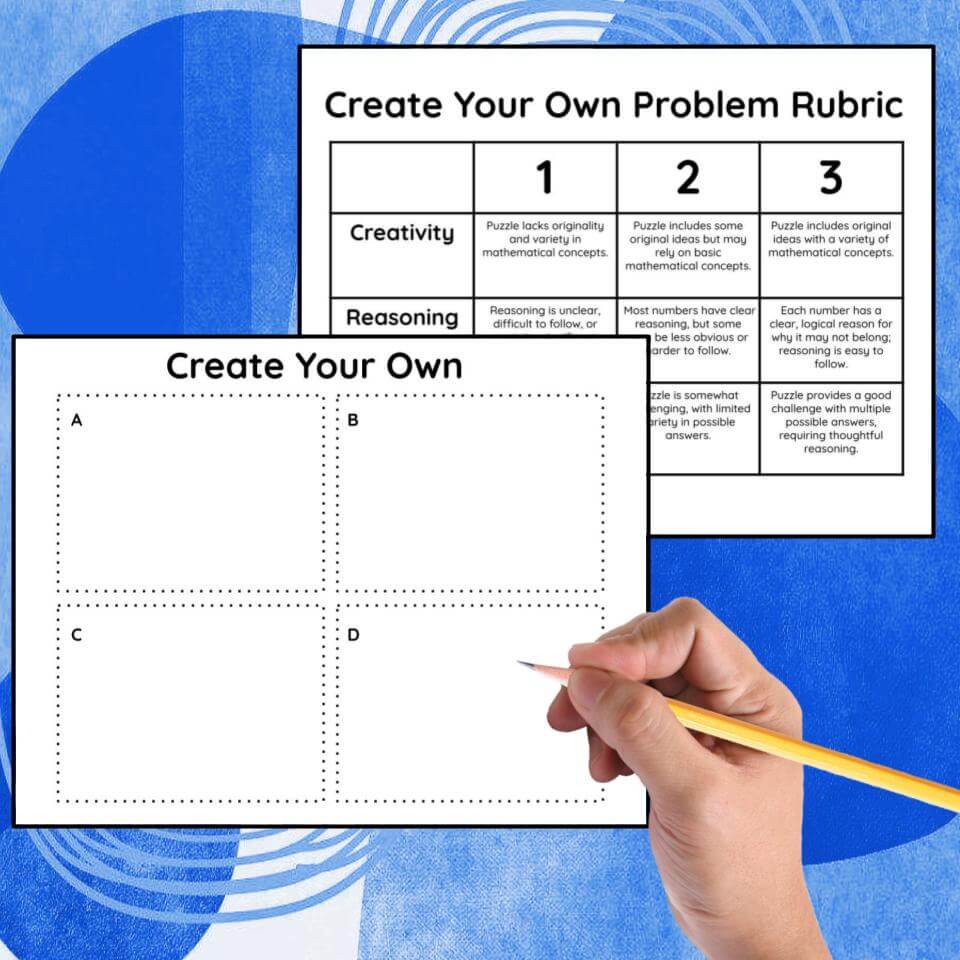
When students understand how WODB works they can create their own problems to share with others. This is a great way to extend a specific concept that you are working on and assess students’ understanding by checking their reasoning for each number. Students will be given a blank template, a blank answer key, and a rubric to check their work. Quality problems should include original ideas with a variety of mathematical concepts. Each number in the grid should have a clear, logical reason for why it may not belong and reasoning should be easy to follow. The problem should also provide a good challenge with multiple possible answers.
If students are struggling to come up with their own problems, it can be helpful to show them some problems that don’t work. We had ChatGPT create some WODB problems for us. While ChatGPT is great at language, it is not yet advanced in math. The problems that it created for us did not work very well. When I asked it to give us four numbers with reasons why each did not belong, it could only come up with reasons for three. Also, one of the numbers it told us was prime was not and one of the multiples was also incorrect. This was a very effective lesson for my students. They had to find the errors and then change the problem to make it effective.
I hope you consider using “Which One Doesn’t Belong?” with your students. It is an effective routine for mathematical critical thinking, vocabulary, and starting conversations. You can get started today by using these free templates to create your own problems or save time with these ready-to-go printable puzzles.

 Enhancing Enrichment
Leave a comment