
Using Socratic Seminar with your gifted and talented students is a great way to strengthen reading comprehension, develop critical thinking skills, and deepen understanding of a topic by actively listening and communicating.

What is a Socratic Seminar?
Socratic Seminar was named after the philosopher Socrates and is based on the Socratic Method of deep probing questions. It is a structured class discussion in which students prepare for a subject by building their background knowledge and then discuss a set topic. The teacher takes a hands-off approach and facilitates with guiding questions as needed.
The typical format of a Socratic Seminar involves two circles. The inner circle participates in the discussion. The outer circle keeps track of the interactions between the participants. If you have a small group of students, feel free to have every student participate and the teacher can keep track of participation and points if you choose.
Why Should I Use Socratic Seminar?
- Strengthen Reading Comprehension
- Develop Critical Thinking Skills
- Actively Listen and Communicate
Strengthen Reading Comprehension
Students begin by preparing for the seminar with a variety of reading materials. They must fully understand the material in order to share their viewpoints and back them up with text evidence. During the seminar they also have the opportunity to listen to other viewpoints to broaden their understanding and gain new perspectives of the material.
Develop Critical Thinking Skills
Students must think critically about the topic in order to analyze information on both sides of an issue. They must also be ready to respond to students that have opposing viewpoints. This requires them to evaluate information, consider multiple perspectives, and form well-reasoned arguments.
Active Listening and Communication Skills
During the Socratic Seminar students must actively listen and respond to other students. They have to follow the conversation and not just read from their notes. They must also analyze the information and relay it in a way that other students can understand. This calls for students to express ideas effectively, engage in respectful debate, and respond thoughtfully to feedback.
How Do I Implement Socratic Seminar?
Before the Seminar:
To get started, choose a topic that students care deeply about. Possibilities include:
- Should kids have phones in school?
- Should schools have more recess?
- Should recycling be required?
- What is your opinion of artificial intelligence?
- Should daylight saving time be continued?
- Should homework be required?
- How much screen time should kids get?
- Should kids get to pick their classroom teacher?
- Should kids participate in online learning on snow days?
- Should there be year-round school?
Provide students with quality reading materials that address both sides of the argument. Students should read the articles and take notes to prepare for the seminar. They may do additional research if time allows.
During the Seminar:
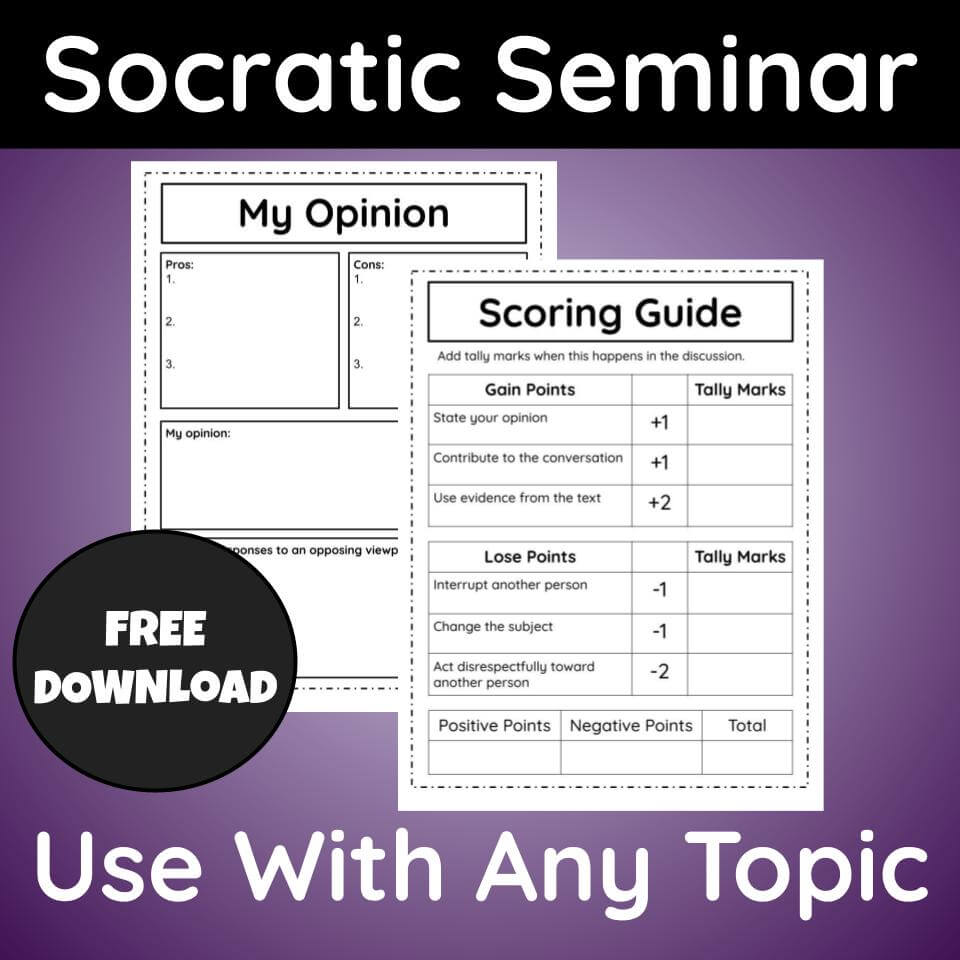
Present the seminar guidelines and the point sheet if using. Ask an opening question. Students can move their chairs into one circle (teacher observes, facilitates, and keeps score) or two circles (outside circle observes and keeps score and then switches places).
Students take turns discussing their viewpoints. They do not raise their hands. Students can start talking after another student has finished. Students will take turns sharing their opinions, text evidence, and respond to other students. Students that have not had a chance to talk should be encouraged to share their thoughts by either the teacher or another student.
The teacher asks guiding questions during the seminar as needed. When the discussion wraps up or time is running out, the teacher asks a closing question and a participant is asked to summarize the discussion.
After the Seminar:
After the seminar concludes, it is important to take some time to reflect. Did everyone participate? Did the group come to a consensus? Students can fill out a reflection sheet independently.
Are you ready to try it out with your students? Download the free Socratic Seminar template today.
 Enhancing Enrichment
Leave a comment