Games are more than just a way to have fun in the classroom. They can encourage critical thinking, increase engagement, and improve your classroom community.
Encourage Critical Thinking and Problem Solving
Games are designed to be open-ended. The same thing does not happen every time you play. This requires students to make choices in the move they make or the card they play. Each move will lead to a different outcome. However, if you realize you didn’t make the best move, there is no harm done. You can make it up on your next turn. This encourages students to take risks in a safe learning environment.
Increase Engagement
Games are designed to be entertaining. When students hear the word game, most associate it with a fun experience. Students get to work with other students without having the pressure of a grade. Many are also motivated by competition. This can be a good thing, as long as students keep in mind that the purpose of the game is to learn and have fun. No one sits passively. Everyone is involved when playing a game.
Improve Classroom Community
While playing games, students learn to work together and communicate with their peers. Regardless of the game being played, students will need to take turns, communicate about what move they made on their turn, and collaborate with their peers if playing on a team. The classroom becomes a fun place where students feel part of a group, feel safe taking academic risks, and are eager to learn new things.
Favorite Math Games for the Gifted Classroom
Please note that some of the links are Amazon affiliate links, and I will earn a small percentage, at no extra cost to you, to help support the website if you purchase using the link.
Blokus

Blokus is a board game for up to four players. There are four different colors with 21 differently shaped pieces. Players take turns placing a piece on the board. The new piece must touch a corner of a previously played piece. This is great for spatial reasoning and problem-solving.
Adsumudi
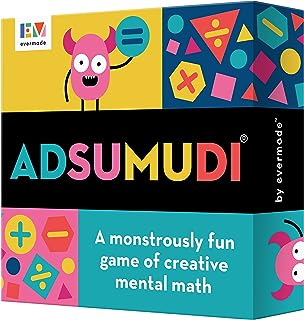
Adsumudi is a combination of the first parts of the words addition, subtraction, multiplication, and division. This game has cards with a target number in the center and five other numbers around it. The objective is to make the target number with the other numbers by adding, subtracting, multiplying, or dividing. The easy version requires using two numbers, while the most complex requires the use of all five numbers. You can try it for free online here. This is great for math problem-solving and flexible thinking.
Set
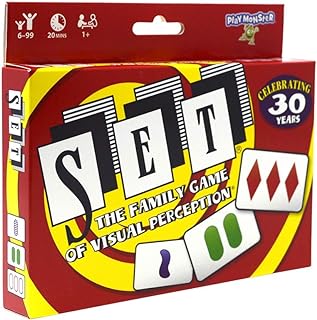
Set does not initially look like a math game. It has a series of cards with three different shapes, three different colors, three different patterns, and three different numbers. You have to create a set where either all three cards are different or all three cards are the same. This game is great for mathematical patterns and quick thinking. You can try it for free online here.
Proof
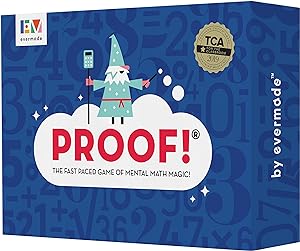
Proof is similar to Adsumudi. Each card has a number from 1 to 100. The numbers are placed in a 3 by 3 array. The first person to create an equation with the sum takes all of the cards. This game is also good for math critical thinking.
Are you interested in math games? Find more favorite math enrichment games in this blog post.
Favorite Reading Games for the Gifted Classroom
Scattergories
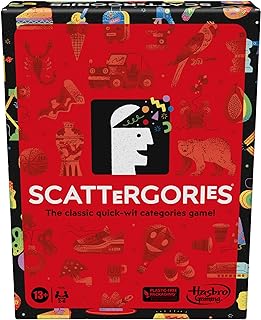
In this game, you are given a letter. You use that letter as the beginning of all of the words for each category. You can try a free online version here. This is great for vocabulary development.
Apples to Apples
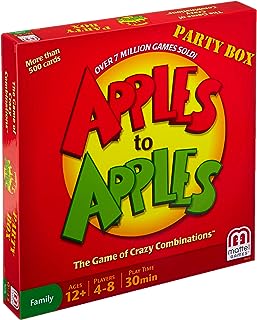
If you are not familiar with Apples to Apples, a green card is drawn that states an attribute. Each player chooses between their red cards for a card that they think displays the attribute best. The judge then chooses which red card they think is best, and that player gets the green card. The player who gets eight green cards (if playing with four players) first wins. You can play this with silent judging, but I have also had fun letting each player plead their case to persuade the judge. This is great for persuasive arguments.
Scrabble
Scrabble is an old favorite. Players create words with their given letters. Certain letters and spaces are worth more points. This is also great for vocabulary, word structure, and critical thinking.
Find links to all of the games on Amazon!
Create Your Own Game
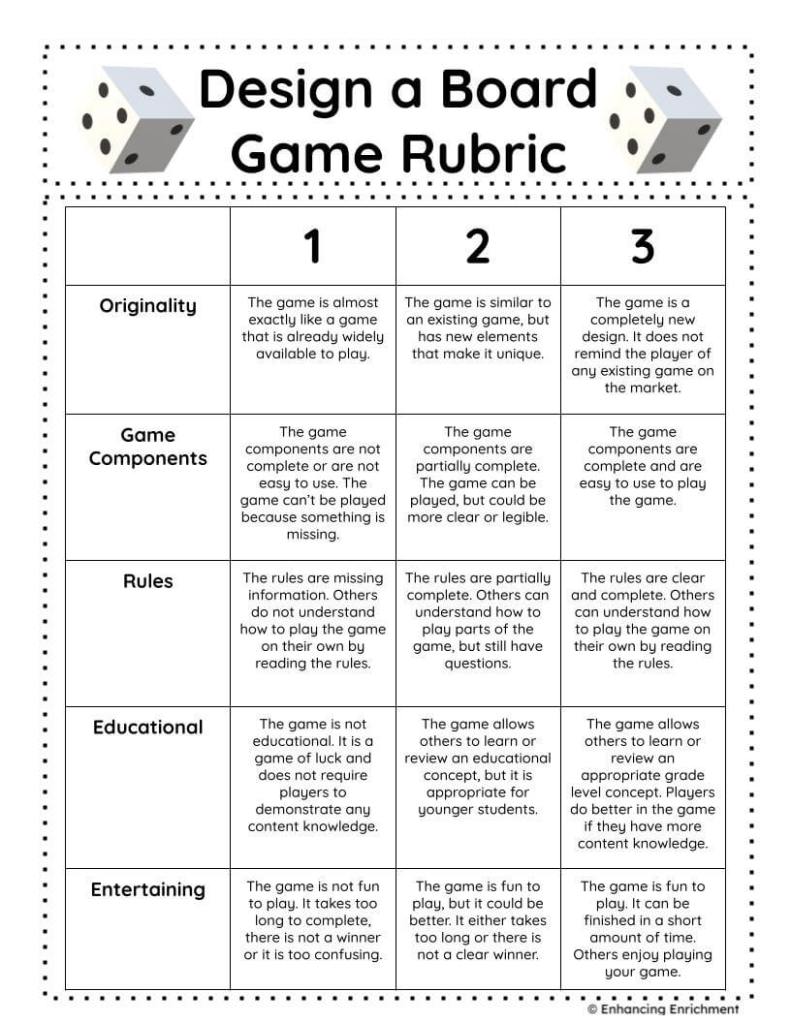
I recently started a project in my Gifted and Talented classroom where students have the opportunity to create their own educational games. First, students brainstorm games they have played. They choose a game that they like and analyze the components. They then choose a topic that they want others to learn. They can create math, reading, vocabulary, science, or even a social studies game. They plan the objective, how to play, and how to win the game. They then create a paper prototype and directions, and let their classmates practice playing it. After receiving feedback, they make adjustments and create a final version to play. This project allows students to be creative and imaginative while still being educational. You can find it here.
Games are a fantastic way to have fun while learning. What are your favorite ways to use games in your classroom?

 Enhancing Enrichment